“How Sugars, Honey and Syrups Shape Flavor, Texture and Liqueur Balance”
Sweeteners do much more than make a homemade liqueur taste sweet. Sugar, honey and syrups influence flavor perception, aroma, color, body, viscosity and the way acidity, bitterness and alcohol are experienced. Understanding these effects makes it easier to create liqueurs that taste balanced rather than simply sugary.
This guide explores the different sugars, honeys and syrups used in liqueur making, along with the science behind sweetness, solubility, dilution and texture. Learn how to select the right sweetener for different ingredients, calculate additions, bench test recipes, avoid common mistakes and balance finished infusions with greater consistency and control.
Sweetening is one of the most important stages of liqueur making. Sugar does much more than make an infusion taste sweet: it changes how alcohol, acidity, bitterness, aroma and texture are perceived, while also influencing the final volume, alcohol strength, colour and overall balance of the finished liqueur. Two batches made from exactly the same infusion can taste remarkably different simply because they have been sweetened differently.
For beginners, the key principle is to treat sweetening as part of formulation rather than as a final attempt to hide harsh flavours. For experienced liqueur makers, the type of sweetener, its concentration and the point at which it is introduced provide another layer of control over flavour, mouthfeel and style. White sugar can preserve the character of delicate fruit, while honey, muscovado, palm sugar and other characterful sweeteners can become important flavour ingredients themselves.
Understanding the relationship between sugar, water and alcohol makes sweetening far more predictable. It allows you to reproduce successful batches, compare different formulations and adjust sweetness without unintentionally diluting the liqueur or overwhelming the original infusion. The aim is not necessarily to make a liqueur as sweet as possible, but to find the concentration at which its aroma, flavour, acidity, bitterness and alcohol integrate into a harmonious whole.
Why Sweeteners Matter in Liqueurs
A sweetener performs several jobs simultaneously. Its most obvious role is providing sweetness, but its sensory influence extends much further. Sugar can soften the impression of alcohol, moderate sharp acidity, make some bitter flavours seem less aggressive and give an otherwise thin infusion greater body. This is why an unsweetened botanical or fruit infusion may taste harsh and disconnected even when the extraction itself has been successful.
Sweetness also determines how individual flavours are perceived. A tart berry infusion may initially seem dominated by acidity, while a carefully measured addition of sugar can reveal ripe fruit, floral and jam-like notes that were already present but difficult to perceive. Likewise, a bitter herbal infusion can become more rounded and complex once sweetness brings its different components into balance.
The choice of sweetener is equally important. Refined white sugar contributes relatively little flavour of its own and is therefore useful when the ingredient should remain the focus. Honey, brown sugar, muscovado, jaggery, coconut sugar and similar sweeteners contribute additional aromas and flavours ranging from floral and caramel to molasses, malt and toasted notes.
Sweetness: determines the basic sweet-to-dry character of the finished liqueur.
Balance: modifies the perception of acidity, bitterness, tannin and alcohol.
Body: increases viscosity and gives the liquid a fuller sensation in the mouth.
Flavour: some sweeteners contribute substantial flavours of their own.
Style: the amount and type of sweetener can move the same infusion from light and fresh to rich and dessert-like.
The Science of Sweetness: Sugar, Alcohol and Water
A finished liqueur is essentially a solution containing alcohol, water, dissolved sugars and extracted flavour compounds. These components interact both physically and sensorially. Understanding this relationship explains why adding syrup changes more than sweetness and why a liqueur often tastes different after sweetening even though none of the original botanical or fruit material has changed.
Sucrose, the main sugar in ordinary table sugar, dissolves readily in water but is much less soluble in high-strength alcohol. Water molecules are particularly effective at surrounding and separating sugar molecules, allowing them to enter solution. For this reason, dissolving sugar in water to make syrup is often the easiest way to incorporate a substantial quantity of sugar into a strong alcoholic infusion.
Alcohol also affects perception. Ethanol can produce warmth, pungency and a drying sensation, especially at higher concentrations. Increasing sugar concentration can make that alcohol seem softer, even though sugar itself has not removed any ethanol. If water is added with the sugar in the form of syrup, however, the actual alcohol by volume also decreases. These are two separate effects: sugar can reduce perceived alcoholic harshness, while added water reduces the actual alcohol concentration.
When to Add Sugar: Before, During or After Infusion?
For most homemade liqueurs, the most controllable approach is to extract the principal ingredient in alcohol first and sweeten after the infusion has been strained. This allows you to judge the strength, acidity, bitterness and aroma of the actual extract before deciding how much sweetness it requires. It also makes it much easier to divide one infusion into several samples and test different sugar concentrations.
Adding sugar during maceration is nevertheless a legitimate technique. It is common in some traditional fruit liqueurs where fruit, alcohol and sugar are combined from the beginning or layered together. Sugar draws water from fresh fruit through osmotic effects and changes the composition of the liquid surrounding the fruit. This can influence the way juice, colour and flavour compounds move into the surrounding solution.
The disadvantage is reduced control. If the extraction becomes too bitter, tart or tannic, the batch is already sweetened and therefore more difficult to evaluate or reformulate. Adding a large quantity of dry sugar directly to a strong spirit can also result in slow dissolution.
Before infusion: useful for certain traditional recipes, but gives you less control over final sweetness and extraction.
During infusion: can encourage juice release from fresh fruit but makes extraction and sweetness harder to evaluate independently.
After infusion: offers the greatest precision and is the recommended starting method when developing a new recipe.
Dry Sugar vs Sugar Syrup
Both dry sugar and prepared syrup can produce excellent liqueurs, but they behave differently during formulation. Dry sugar adds sugar without deliberately introducing additional water. This can be useful when you want to preserve a relatively high alcohol concentration or avoid unnecessary dilution. Its main disadvantage is that sugar dissolves increasingly slowly as the alcohol concentration rises.
Sugar syrup is made by dissolving sugar in water before adding it to the infusion. Because the sugar is already dissolved, syrup mixes quickly and evenly. This makes it particularly convenient for bench testing, recipe development and precise adjustments. The additional water also provides a practical way to reduce the alcohol strength while increasing sweetness.
The important point is to record the composition of the syrup rather than simply recording that "syrup" was added. Adding 200 ml of a light syrup is not equivalent to adding 200 ml of a concentrated syrup. The two additions contain different quantities of sugar and water and therefore produce different sweetness, dilution and final volume.
Dry sugar: useful when minimising added water is important.
Simple syrup: convenient, predictable and easy to incorporate.
Rich syrup: delivers more sugar with less added water than a lighter syrup.
Best practice: record sugar and water by weight whenever repeatability matters.
Understanding Sugar Concentration and Liqueur Ratios
Reliable liqueur making becomes much easier when sugar is measured as part of a formulation rather than added according to vague descriptions such as "one cup" or "sweeten to taste." A useful starting measurement is grams of sugar per litre of finished liqueur. This allows recipes to be compared and scaled regardless of batch size.
There is no universal ideal concentration. A light, aromatic citrus or floral liqueur may benefit from restrained sweetness, while a strongly bitter herbal liqueur or rich dessert-style liqueur may require considerably more sugar to achieve balance. The natural sugar present in fruit and the sweetness contributed by honey, syrups or other ingredients must also be considered.
For recipe development, small-scale bench trials are extremely useful. Divide a measured quantity of finished infusion into identical samples and sweeten each one to a different calculated concentration. After mixing, allow the samples to rest before comparing them. This produces much more useful information than repeatedly adding sugar to the entire batch.
Measure the infusion: record the volume and, when possible, its alcohol strength.
Choose trial concentrations: prepare several samples with progressively greater sweetness.
Keep accurate records: note the grams of sugar and water added to each sample.
Allow the samples to integrate: avoid making the final judgement immediately after mixing.
Scale the preferred ratio: apply the successful formulation to the remaining infusion.
How Sweeteners Affect Alcohol Strength and Final Volume
Sweetening can substantially change both the final volume and alcohol strength of a liqueur. This is particularly important when sugar is introduced as syrup. Suppose an infusion begins with a particular volume and alcohol by volume. Adding syrup increases the total volume without adding any additional ethanol, so the ethanol becomes distributed through a larger quantity of liquid and the final ABV decreases.
A simplified way to think about dilution is to track the amount of pure alcohol already present. If 1 litre of infusion is 40% ABV, it contains approximately 400 ml of pure ethanol. If non-alcoholic ingredients increase the final volume to 1.25 litres, those 400 ml of ethanol are now distributed throughout 1.25 litres rather than 1 litre. The resulting alcohol concentration is therefore lower.
Dry sugar is more complicated than simply assuming that it adds no volume. Dissolved sugar contributes to the volume and density of the finished solution, so professional formulation should not assume that adding 300 g of sugar leaves the original liquid volume unchanged. For practical homemade production, measuring the actual final volume after complete dissolution gives a better basis for calculations.
This distinction matters when reproducing recipes. Recording only the starting spirit strength and amount of sugar does not fully describe the finished liqueur. For consistent batches, record the starting volume, starting ABV, quantities of sugar and water added, and final volume.
How Sugar Affects Flavor Extraction
Sugar is often described as if it simply "extracts flavour," but the actual process is more nuanced. During alcoholic maceration, ethanol and water perform much of the solvent work. Different flavour compounds have different affinities for alcohol and water, which is why the strength of the spirit influences what is extracted from fruit, herbs, spices and other ingredients.
When sugar is present with fresh fruit, it creates osmotic pressure that encourages water and dissolved substances to move out of fruit tissues. This is one reason fruit covered with sugar quickly begins producing a syrup. When alcohol is also present, extraction involves a combination of tissue breakdown, diffusion, osmosis and the solvent properties of the alcohol-water mixture.
Adding substantial sugar during maceration changes the environment in which extraction occurs. It alters viscosity and the relative proportions of sugar, water and alcohol surrounding the ingredient. This does not automatically make extraction better or worse, but it can make it different and less directly comparable with an unsweetened alcoholic infusion.
For experimental recipe development, extracting first and sweetening later makes it easier to separate two variables: how much flavour was extracted and how much sugar produces the best balance. Once a successful recipe has been established, sugar can intentionally be introduced earlier if testing shows that it improves the desired style.
How Sugar Affects Color
Refined white sugar contributes very little colour of its own, making it particularly useful for pale fruit, floral and citrus liqueurs where preserving the natural appearance is important. Darker sweeteners can have a much greater effect. Brown sugar, muscovado, jaggery, coconut sugar, palm sugar, molasses, dark honey and some syrups can shift a liqueur toward gold, amber, brown or even deep mahogany.
The visual effect depends on both the colour of the sweetener and the colour already present in the infusion. A small amount of dark sugar may enrich a naturally brown coffee or walnut liqueur attractively while making a pale elderflower or pear liqueur appear muddy. Sweetener selection should therefore be treated as part of colour design as well as flavour design.
Sugar concentration can also alter the visual impression of a liqueur by changing its density and optical properties. A richer solution may appear more substantial and glossy in the glass. However, sugar itself should not be expected to preserve unstable natural pigments indefinitely. Light, oxygen, temperature, pH and the chemistry of individual plant pigments remain major factors in colour stability.
White sugar: best when minimal colour contribution is required.
Golden and raw sugars: can introduce warm golden or amber tones.
Muscovado and dark sugars: can substantially deepen the colour.
Honey: ranges from almost colourless to very dark depending on variety.
How Sugar Affects Mouthfeel, Body and Texture
One of the most important differences between a flavoured spirit and a liqueur is mouthfeel. Dissolved sugar increases the density and viscosity of the liquid, creating a fuller, smoother sensation on the palate. As sugar concentration increases, the liquid can move from relatively light and spirit-like to rich, rounded and almost syrupy.
This physical effect works together with sensory perception. Alcohol can feel sharp and drying, while dissolved sugar produces softness and weight. A well-balanced sugar concentration can therefore make a liqueur feel smoother even when it retains a relatively substantial alcohol content.
More body is not always better. Delicate lemon, berry, flower or herb liqueurs can lose freshness if excessive sugar gives them a heavy texture. Conversely, coffee, chocolate, nut, spice and strongly bitter botanical liqueurs may benefit from greater viscosity because it supports their richer flavour profile.
The objective is to match texture to style. When developing a recipe, evaluate not only whether the liquid is sweet enough, but also how it moves across the palate, whether it feels thin or heavy and how long the finish remains after swallowing.
How Sugar Changes Perceived Acidity, Bitterness and Alcohol Heat
Sugar does not simply remove acidity or bitterness. Instead, sweetness changes the way the brain interprets these competing sensations. A highly acidic berry infusion remains acidic after sweetening, but the acidity may feel brighter and more fruit-like rather than aggressively sour. This interaction is fundamental to the balance of many fruit liqueurs.
The same principle applies to bitterness. Sweetness can reduce the perceived intensity of bitter compounds, which is why sugar is particularly important in liqueurs containing citrus peel, coffee, cocoa, roots, bark and strongly bitter botanicals. However, adding more sugar is not always the correct solution to excessive bitterness. If too many bitter compounds have been extracted, extreme sweetness may merely create a liqueur that tastes both excessively sweet and excessively bitter.
Alcohol heat can also appear softer after sweetening. Part of this is sensory masking: sweetness and increased viscosity reduce the prominence of ethanol's burning sensation. If syrup is used, there is an additional physical effect because the added water actually lowers the ABV.
Too acidic: sweetness may restore balance, but severe acidity may require broader recipe adjustment.
Too bitter: moderate sweetness can soften bitterness; over-extraction should be corrected rather than hidden.
Too alcoholic: sugar can soften perceived heat, while water or syrup can reduce the actual ABV.
Too sweet: additional acidity or bitterness may improve balance, but excessive sugar is difficult to remove once added.
How Sweetness Changes Aroma and Flavor Perception
Sweetness can dramatically change the apparent flavour of a liqueur even when no additional aromatic ingredients have been added. Taste and aroma are interpreted together by the brain, so increasing sweetness can make certain fruit, vanilla, floral, caramel and ripe flavours seem more prominent. This is one reason an unsweetened fruit infusion may smell promising but taste surprisingly austere.
The effect is especially noticeable with fruit. Sweetening a raspberry, cherry, plum or blackcurrant infusion can shift its perceived character from tart and vinous toward ripe, juicy or preserve-like. With vanilla, cinnamon and baking spices, sweetness may reinforce associations with desserts and confectionery. In herbal liqueurs, it can move attention away from medicinal bitterness and toward aromatic complexity.
However, excessive sweetness can have the opposite effect. Once sugar dominates the palate, subtle distinctions between ingredients become harder to appreciate. Delicate floral notes, fresh citrus character and fine herbal nuances can become buried beneath a broad impression of sweetness. Heavy syrups can also change the way volatile aromas are experienced as the liqueur is tasted.
This is why the best sweetness level cannot be determined by a number alone. The final decision should be sensory. Taste the liqueur at several sugar concentrations and consider sweetness, aroma, acidity, bitterness, alcohol warmth, texture and finish together. The ideal point is usually where sugar supports the original ingredients without becoming the main flavour itself.
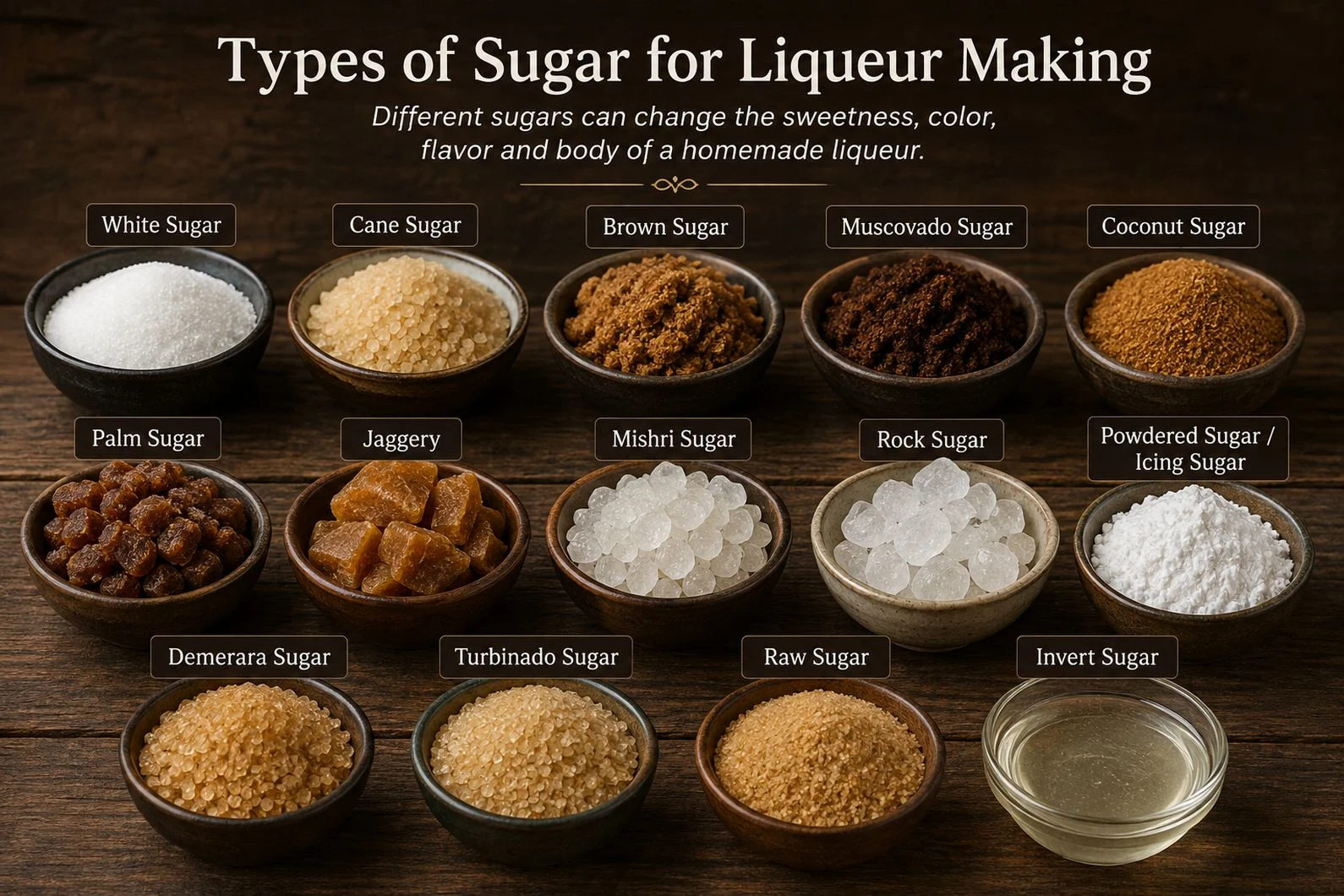
Different sugars can change the sweetness, color, flavor and body of a homemade liqueur.
Types of Sugar for Liqueur Making
Choosing sugar for a liqueur is not simply a question of how much sweetness you want. Different sugars contribute different flavours, colours, aromas and textures, and these characteristics can noticeably change the finished drink. Refined white sugar is relatively neutral and allows delicate fruit, flowers and botanicals to remain prominent, while darker sugars such as muscovado, jaggery and some palm sugars can introduce caramel, molasses, toasted and earthy notes of their own.
The physical form of sugar also matters. Fine crystals dissolve more quickly than large crystals, while powdered sugar may contain anti-caking ingredients that are undesirable in a clear liqueur. Some traditional crystalline sugars, including mishri and rock sugar, dissolve slowly but can still produce a clean sweetness. Invert sugar behaves differently again because its sucrose has been broken into glucose and fructose, giving it useful properties for concentrated syrups and smooth-textured liqueurs.
For recipe development, it is useful to think of sugar as both a sweetener and an ingredient. The more characterful the sugar, the more carefully it should be matched to the ingredients being infused. When testing an unfamiliar sugar, sweeten small samples of the same base infusion and compare them side by side before committing the entire batch.
White Sugar
White granulated sugar is the most versatile starting point for homemade liqueur making. It consists primarily of refined sucrose and contributes a clean sweetness with very little additional aroma, flavour or colour. This neutrality makes it particularly valuable when you want the character of fruit, flowers, herbs or spices to remain the focus of the liqueur.
White sugar is especially suitable for lemon and other citrus liqueurs, delicate berry infusions, pear, apple, peach, floral liqueurs and lightly flavoured botanical recipes. It is also useful during recipe development because it introduces relatively few additional flavour variables. If an infusion tastes balanced with white sugar, you can subsequently experiment with more characterful sweeteners and clearly identify what they contribute.
It can be added directly or dissolved in water to make syrup. Direct addition introduces less water but can dissolve slowly in high-strength alcohol. A prepared syrup incorporates more easily but lowers the final ABV because it introduces additional water.
Flavor: clean and neutral.
Color: minimal influence.
Best for: fruit, citrus, floral and delicate herbal liqueurs.
Main advantage: lets the infused ingredients remain the dominant flavour.
Cane Sugar
Cane sugar is produced from sugar cane, but the term can describe products at different levels of refinement. Fully refined white cane sugar behaves much like ordinary white granulated sugar, whereas less-refined cane sugars may retain small amounts of cane-derived flavour and colour. Always examine the actual product rather than assuming that every package labelled "cane sugar" will behave identically.
Lightly refined cane sugar can contribute a subtle warmth without dramatically altering the infusion. This makes it useful for liqueurs where completely neutral sweetness is unnecessary but strong molasses character would be excessive. Pineapple, banana, orange, tropical fruit, vanilla and warm spices are particularly natural partners.
When substituting cane sugar for white sugar, compare the sugars by weight rather than volume. Crystal size can make volume measurements misleading. For repeatable liqueur recipes, grams of sugar per batch or per litre provide a much more reliable formulation.
Brown Sugar
Brown sugar combines sucrose with varying amounts of molasses. Depending on whether it is light or dark, it can contribute caramel, toffee and mild molasses flavours in addition to sweetness. These characteristics make brown sugar much more influential than refined white sugar.
Light brown sugar works well when only a modest caramel character is desired, while dark brown sugar is more appropriate for robust liqueurs capable of supporting deeper molasses notes. It pairs naturally with apple, pear, plum, banana, fig, dried fruit, coffee, chocolate, nuts, vanilla, cinnamon, clove and other warming spices.
Its colour must also be considered. Even a moderate quantity can shift a pale infusion toward amber or brown. This may enhance an aged or autumnal style but can diminish the fresh appearance of delicate citrus, flower or pale-fruit liqueurs.
Light brown sugar: mild caramel and toffee character.
Dark brown sugar: stronger molasses flavour and deeper colour.
Best for: dark fruit, apple, coffee, chocolate, nuts and spices.
Use carefully with: delicate floral and pale fruit infusions.
Muscovado Sugar
Muscovado is a moist, minimally refined cane sugar with a pronounced molasses character. It can contribute flavours reminiscent of treacle, caramel, dried fruit, malt and dark toffee. Dark muscovado is particularly powerful and should be regarded as a flavouring ingredient rather than simply a source of sweetness.
It works exceptionally well in robust liqueurs containing coffee, cacao, walnut, hazelnut, dried fruit, orange peel, vanilla or warming spices. It can also complement dark rum or brandy-based infusions, where its molasses character reinforces flavours already present in the spirit.
For delicate ingredients, however, muscovado can easily become dominant. Instead of replacing all white sugar with muscovado, try blending the two. A predominantly neutral sugar base with a smaller percentage of muscovado can introduce depth while preserving the original ingredient character.
Coconut Sugar
Coconut sugar is produced from the sap of coconut palm flowers rather than from coconut flesh. Its flavour therefore does not usually resemble fresh coconut. Instead, it tends to provide caramel, toasted, malty and lightly earthy notes, with the exact character varying between producers.
Its warm flavour makes it particularly interesting for banana, pineapple, mango, coffee, cacao, vanilla, cinnamon and other tropical or dessert-style liqueurs. It can also work with aged rum, brandy and whisky-based infusions where a neutral sugar would contribute sweetness but little additional complexity.
Coconut sugar is darker and more flavourful than white sugar, so complete substitution can significantly change both colour and flavour. Bench testing is recommended before using it in delicate recipes. If the character is too strong, blending coconut sugar with white sugar often provides a better balance.
Palm Sugar
Palm sugar is made from the sap of various palm species and is commonly sold as blocks, cakes, pastes or granules. Its flavour varies considerably according to the palm, region and processing method. Good palm sugar can offer complex caramel, butterscotch, smoky, nutty and slightly fermented notes.
These characteristics make palm sugar particularly suitable for tropical fruit and spice liqueurs. Pineapple, banana, mango, tamarind, coconut, ginger, cinnamon, cardamom and vanilla can all pair successfully with its deeper flavour. Rum-based liqueurs are another natural application.
Because palm sugar products are not standardized, two brands may produce noticeably different results. Taste the sugar before formulating the liqueur and record the specific product used when repeatability is important. Solid blocks should normally be chopped or grated and dissolved before addition.
Jaggery
Jaggery is an unrefined or minimally refined sugar traditionally made from sugar cane juice or palm sap. Unlike highly refined sugar, it retains more of the original material's non-sucrose components, producing a complex flavour that can include caramel, molasses, malt, dried fruit, earthiness and occasionally smoky or mineral notes.
In liqueur making, jaggery is best used where its distinctive character becomes part of the intended flavour profile. It can complement ginger, cardamom, cinnamon, clove, coffee, tea, tamarind, banana, dried fruit and roasted ingredients. It can also create interesting results with rum and brandy.
Jaggery varies substantially in composition and flavour. It may also contain more insoluble material than refined sugar, potentially creating sediment or haze. Dissolving it separately in a small amount of warm water and filtering the solution before blending can improve consistency and clarity.
Mishri Sugar
Mishri is a traditional crystallized sugar commonly found as large translucent crystals. Chemically, it is predominantly sucrose and therefore provides a relatively clean sweetness compared with strongly flavoured unrefined sugars. Its large crystal structure affects dissolution speed more than the fundamental character of the sweetness.
For liqueur making, mishri can be used where a clean sugar profile is desired, including fruit, flower, spice and herbal preparations. It may also be attractive for recipes inspired by South Asian flavour combinations involving cardamom, fennel, rose, saffron or aromatic herbs.
Large crystals dissolve slowly, particularly in high-strength alcohol. Crushing the crystals or dissolving them in water before addition greatly speeds incorporation. There is generally no technical advantage in waiting for very large crystals to dissolve slowly unless that process is deliberately part of a traditional preparation.
Rock Sugar
Rock sugar consists of large crystallized pieces of sucrose and may be white, clear, pale yellow or amber depending on how it has been produced. It is widely used in culinary infusions and traditional preparations because it is easy to portion and dissolves gradually.
From a liqueur-making perspective, refined rock sugar behaves similarly to other sucrose-based sugars once it is completely dissolved. Claims that it is inherently much less sweet than ordinary sugar should therefore be treated cautiously: differences experienced in practice often arise from crystal size, measurement method, processing or incomplete dissolution rather than a fundamentally different sugar molecule.
Rock sugar can work with fruit, citrus, tea, herbs and spices. Because the crystals are large, measuring by weight is particularly important. A cup of irregular rock sugar crystals does not contain the same mass of sugar as a tightly packed cup of granulated sugar.
Powdered Sugar / Icing Sugar
Powdered sugar is finely milled sucrose designed to dissolve quickly. At first glance this seems ideal for liqueur making, but commercial icing sugar frequently contains a small amount of starch or another anti-caking agent. That additional material can cause haze, sediment or an undesirable texture in a liqueur.
For this reason, ordinary granulated sugar or pure caster sugar is generally preferable when clarity matters. If powdered sugar is used, check the ingredient declaration carefully. A product containing only sugar behaves differently from one containing starch.
Powdered sugar can still be useful in opaque or creamy preparations where absolute clarity is irrelevant, but its rapid dissolution alone usually provides little advantage because granulated sugar can easily be converted into a clear syrup.
Advantage: dissolves rapidly.
Disadvantage: may contain starch or anti-caking agents.
Best practice: check the ingredients before using it in a clear liqueur.
Demerara Sugar
Demerara is a coarse, golden-brown cane sugar known for large crystals and a gentle caramel or toffee character. It is more expressive than white sugar but generally less intense than dark muscovado, making it a useful middle ground for liqueur makers who want additional depth without strong molasses flavours.
It pairs especially well with orange, apple, pear, peach, apricot, pineapple, vanilla, coffee, nuts and warming spices. Demerara is also particularly compatible with rum and brandy-based liqueurs, where its subtle cane and caramel character can reinforce the base spirit.
Because of its large crystals, dissolving demerara as a syrup is often convenient. A demerara syrup can be prepared separately and added gradually during bench testing, allowing both sweetness and caramel character to be adjusted precisely.
Turbinado Sugar
Turbinado is a partially refined cane sugar with relatively large golden crystals and a mild molasses or caramel flavour. Although it is sometimes grouped together with demerara, the two are not necessarily identical in processing, moisture or flavour intensity.
In liqueurs, turbinado provides more character than refined white sugar while generally remaining less dominant than muscovado or dark brown sugar. This makes it useful for citrus, stone fruit, tropical fruit, vanilla, tea, spice and nut liqueurs.
Its golden colour can subtly warm the appearance of pale infusions. As with other coarse sugars, measure by weight and ensure complete dissolution before judging sweetness. Undissolved crystals can make an early tasting misleading.
Raw Sugar
"Raw sugar" is a broad commercial description rather than one precise type of sugar. Products sold under this name are usually partially refined cane sugars that retain some molasses-derived colour and flavour. Depending on the product, they may resemble turbinado, demerara or another lightly processed cane sugar.
For liqueur making, the practical characteristics of the actual sugar matter more than the label. Examine its colour, aroma, crystal size and flavour before deciding how it will affect a recipe. Pale raw sugars may contribute only subtle caramel notes, whereas darker examples can noticeably influence the finished liqueur.
Raw sugar can be an effective general-purpose option for robust fruit, citrus, spice and rum-based liqueurs. For recipes that need exact repeatability, however, record the brand or specific type because the term "raw sugar" alone does not adequately describe the ingredient.
Invert Sugar
Invert sugar is produced when sucrose is split into its component simple sugars, glucose and fructose. This process, called inversion, can be achieved using acid and heat or with enzymes. The resulting syrup behaves differently from an equivalent solution made entirely from intact sucrose.
Invert sugar is useful in liqueur making because it remains highly soluble and is less prone to crystallization in concentrated solutions. Fructose is also sweeter than sucrose under many tasting conditions, so invert syrup can produce a different sweetness profile and may achieve the desired perceived sweetness with a different sugar concentration.
Its smooth texture makes it particularly useful for rich dessert liqueurs, concentrated fruit liqueurs and formulations containing high sugar levels. It can also be blended with ordinary sucrose rather than used as the sole sweetener.
Commercial invert syrups vary in concentration, so recipes should specify the amount of actual sugar solids rather than treating every invert syrup as interchangeable. When making invert syrup at home, accurate weighing of sugar and water improves consistency considerably.
Comparing Sugars: Sweetness, Flavor, Color and Mouthfeel
The best sugar is determined by the intended character of the liqueur rather than by a universal hierarchy of quality. If the objective is to preserve the pure aroma of raspberry, lemon or elderflower, refined white sugar may be the most appropriate choice. If the objective is to create a rich walnut, coffee or spiced rum liqueur, a characterful sugar may contribute desirable complexity.
Sweetness should not be compared using spoonfuls or cups. Different crystal sizes and moisture contents produce different weights for the same volume. Weighing sugars provides a much more reliable comparison. Even when equal weights are used, the sensory result may differ because some products contain glucose, fructose, molasses and other components in addition to sucrose.
White sugar: neutral flavour, minimal colour and excellent for delicate ingredients.
Cane sugar: ranges from neutral to gently cane-like depending on refinement.
Brown sugar: caramel and molasses character with increasing colour intensity.
Demerara and turbinado: moderate caramel depth without the intensity of dark sugars.
Muscovado: powerful molasses, treacle and dark-fruit character.
Coconut and palm sugars: caramelized, toasted and sometimes earthy complexity.
Jaggery: rich and highly characterful, with substantial variation between products.
Mishri and refined rock sugar: predominantly clean sucrose sweetness with slower dissolution because of crystal size.
Powdered sugar: fast dissolving but potentially problematic when anti-caking ingredients are present.
Invert sugar: highly soluble, resistant to crystallization and useful for concentrated formulations.
For advanced recipe development, one of the most effective techniques is to combine sugars. White sugar can provide the majority of the required sweetness while a smaller amount of muscovado, demerara, coconut sugar or jaggery contributes flavour. This separates the need for sweetness intensity from the desire for sweetener character and provides much finer control over the finished liqueur.
Whatever sugar you choose, document the formulation by weight. Record the sugar type, amount used, added water, starting infusion volume and final volume. This turns an experimental batch into a reproducible recipe and makes future adjustments to sweetness, colour, body and alcohol strength considerably easier.
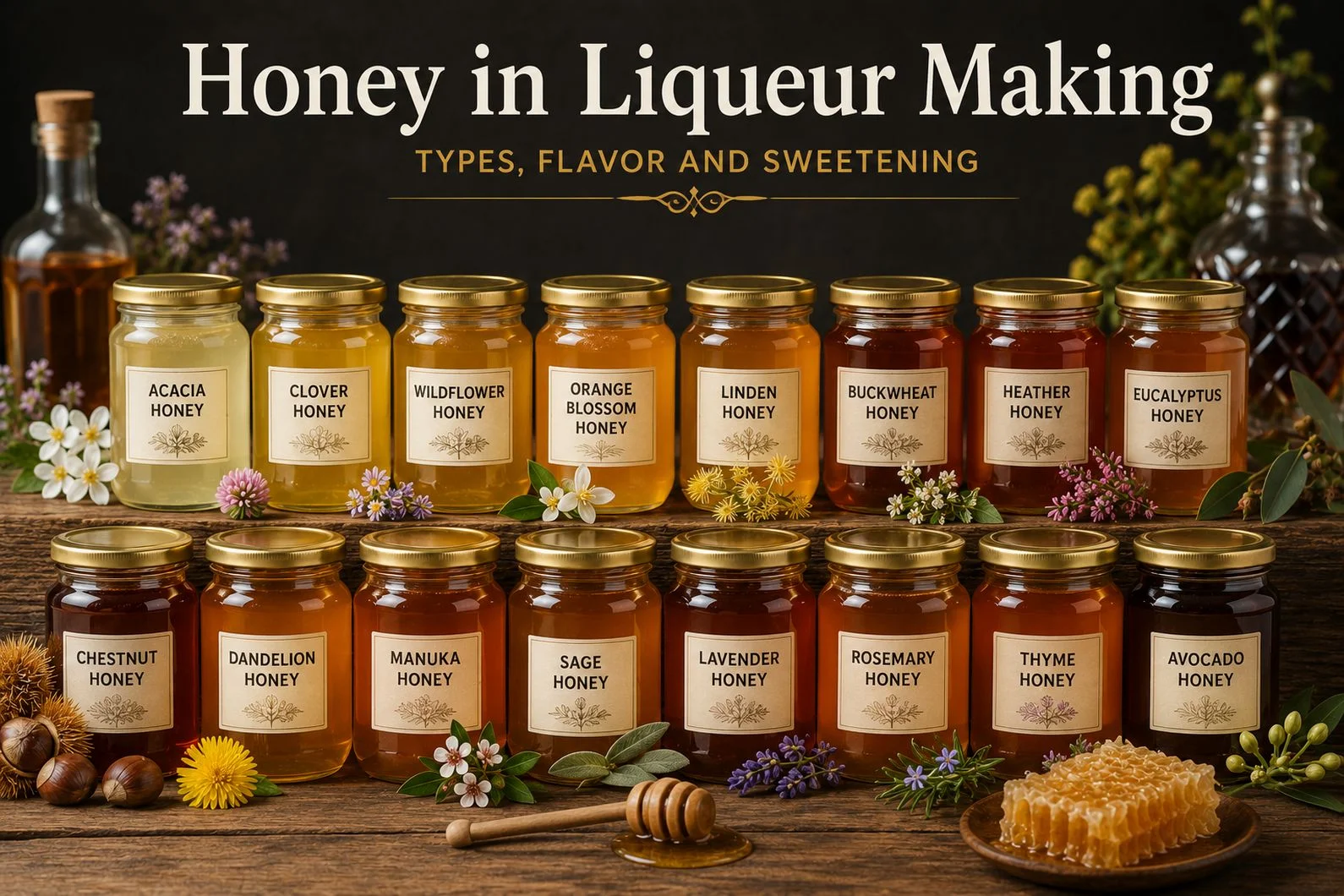
Different honeys can add sweetness, floral aroma, color, texture and distinctive flavor to homemade liqueurs.
Honey in Liqueur Making
Honey is one of the most interesting sweeteners available to a liqueur maker because it contributes far more than sweetness. Depending on its floral origin, honey can introduce delicate blossom aromas, citrus notes, herbs, malt, caramel, dried fruit, earthiness or even pleasantly bitter characteristics. Choosing a honey can therefore influence a liqueur almost as much as choosing an additional botanical ingredient.
Unlike refined white sugar, honey is not simply sucrose. It is primarily a mixture of fructose and glucose with water, organic acids, minerals, enzymes and numerous minor aromatic compounds. Its exact composition varies according to botanical origin, geographical location, processing and storage. This natural variation is part of honey's appeal, but it also means that two honeys can behave and taste very differently in the same recipe.
Honey is particularly useful in fruit, herbal, floral, spice, nut and brandy-based liqueurs. Light varieties can add sweetness while preserving delicate aromas, whereas dark honeys can become a major component of the flavour profile. For reliable results, honey should be selected by flavour rather than simply by sweetness, introduced gradually and recorded by weight when developing repeatable recipes.
Using Honey as a Liqueur Sweetener
Honey can replace some or all of the conventional sugar in a liqueur, but direct substitution should be approached carefully. Honey already contains water and its sugars are primarily glucose and fructose rather than sucrose. It also contributes its own flavour, acidity, colour and aroma. Replacing 300 g of granulated sugar with 300 g of honey therefore does not produce exactly the same formulation.
For beginners, one of the easiest methods is to complete the alcoholic extraction first, strain the infusion and then add honey gradually. This keeps extraction and sweetening as separate stages and makes it easier to judge how much honey character the liqueur can support.
Honey can be incorporated directly, but viscous or crystallized honey may mix slowly with a strong alcoholic infusion. Gently warming the honey or diluting it with a measured quantity of warm water can make blending easier. Excessive heating should be avoided when preserving delicate floral aromas is important.
Choose the honey: match its aroma and flavour intensity to the ingredients in the infusion.
Weigh it: use grams rather than spoon or cup measurements for repeatable results.
Prepare a small trial: sweeten a measured sample before modifying the whole batch.
Add gradually: honey flavour can become dominant before the liqueur appears excessively sweet.
Allow it to rest: reassess sweetness, aroma and texture after the honey has fully integrated.
How Honey Behaves Differently from Sugar
Granulated white sugar is predominantly sucrose, whereas honey contains substantial proportions of fructose and glucose together with water and numerous minor components. Fructose is particularly important because it generally produces a stronger perception of sweetness than sucrose under comparable conditions. Consequently, honey cannot always be substituted for granulated sugar purely on a gram-for-gram sensory basis.
The water naturally present in honey also matters. When honey is added to an alcoholic infusion, both sugars and water enter the formulation. This can contribute to a small reduction in alcohol concentration. The exact effect depends on the honey's moisture content and the quantity used.
Honey also contains compounds that refined sugar does not. Proteins, pollen-derived material, minerals, organic acids and other components can influence flavour, aroma and clarity. Some honey-sweetened liqueurs develop haze or fine sediment during maturation, particularly when relatively unprocessed honey is used.
White sugar: predominantly sucrose with minimal aroma and colour.
Honey: primarily fructose and glucose, plus water and minor aromatic components.
Sweetness: honey may taste sweeter than an equivalent weight of sucrose depending on composition and serving conditions.
Flavor: honey can become an important part of the liqueur's flavour profile.
Clarity: honey is more likely than refined sugar to introduce haze or sediment.
Acacia Honey
Acacia honey is one of the most useful honeys for delicate liqueurs. It is typically pale, mild and gently floral, with a clean sweetness that does not easily overpower subtle ingredients. It is therefore an excellent transition for liqueur makers who want to experiment with honey without introducing the strong flavour associated with darker varieties.
It pairs particularly well with pear, apple, peach, apricot, grape, lemon, elderflower, chamomile and other gentle floral or fruit ingredients. Acacia honey can also complement vanilla and lightly aromatic herbs where a dark honey would introduce too much flavour or colour.
Another practical characteristic is its tendency to remain liquid for relatively long periods because of its naturally high fructose-to-glucose ratio. This makes it convenient to weigh and blend. Its pale colour is also advantageous when maintaining the natural appearance of a light-coloured liqueur is important.
Character: delicate, clean and lightly floral.
Color: very pale to light gold.
Best with: pear, peach, apricot, lemon, elderflower and chamomile.
Intensity: low, making it suitable for subtle liqueurs.
Clover Honey
Clover honey generally has a mild, familiar honey character with gentle floral and grassy notes. Its flavour is more noticeable than extremely neutral sweeteners but usually restrained enough to work across a wide range of liqueur styles.
This versatility makes clover honey useful for apple, pear, peach, berries, lemon, vanilla, cinnamon and many herbal infusions. It can provide recognisable honey character without necessarily turning the liqueur into a honey-dominated drink.
Because clover honey can vary according to geographical origin and the mixture of nectar sources available to bees, tasting the specific batch remains important. A mild clover honey can often replace part of the white sugar in a recipe while retaining good ingredient definition.
Wildflower Honey
Wildflower honey is produced from nectar collected from a mixture of flowering plants rather than one dominant botanical source. As a result, there is no single wildflower honey flavour profile. One batch may be pale and floral, while another can be dark, herbal, fruity or strongly aromatic.
This variation makes wildflower honey particularly interesting for artisanal liqueur making. It can add a sense of place and botanical complexity to berry, stone fruit, herbal and floral infusions. However, it also means that a recipe made with one wildflower honey may taste noticeably different when reproduced with another.
For repeatable production, record the producer, origin and harvest where possible. For experimental batches, treat wildflower honey as an individual ingredient: smell and taste it before deciding which infusion it should accompany.
Character: highly variable and potentially complex.
Best approach: match the specific honey rather than relying on the name alone.
Best with: berries, stone fruits, herbs, flowers and botanical liqueurs.
Orange Blossom Honey
Orange blossom honey is particularly attractive for liqueur making because its floral and citrus associations naturally complement many fruit-based infusions. Good examples can show orange blossom, light citrus, fresh floral and gently fruity aromas while remaining relatively elegant.
It is an excellent partner for orange, lemon, mandarin, grapefruit, peach, apricot and vanilla. It can also add complexity to floral liqueurs and works particularly well when the objective is to reinforce citrus character without simply adding more peel.
When using orange blossom honey in a citrus liqueur, consider reducing other strongly aromatic additions initially. The honey should be given enough room to contribute its own floral character. Excessive quantities of strongly bitter citrus peel can easily obscure the subtle aroma that makes this honey distinctive.
Linden / Lime Blossom Honey
Linden honey, also known as lime blossom honey in parts of Europe, is produced from the flowers of Tilia species. It can have a distinctive floral, herbal and slightly mentholated character, sometimes accompanied by fresh, woody or balsamic notes.
This makes linden honey particularly interesting for herbal and botanical liqueurs. It can pair with lemon, mint, lemon balm, chamomile, elderflower and selected aromatic herbs. It can also provide an intriguing counterpoint to berry and stone-fruit infusions where a fresh herbal dimension is desirable.
Linden honey is more characterful than very mild honeys such as acacia, so it should be introduced carefully. Small additions can provide complexity, whereas large quantities may shift the entire flavour profile toward its distinctive herbal character.
Heather Honey
Heather honey is typically much more assertive than pale floral honeys. It can display strong floral, woody, herbal, caramel and slightly bitter characteristics, often with a lingering finish. Its intensity makes it particularly suitable for robust liqueurs rather than delicate infusions.
Dark berries, blackberry, bilberry, plum, sloe, coffee, nuts and warming spices can all provide sufficient flavour intensity to accompany heather honey. It is also a strong candidate for brandy or whisky-based liqueurs where the base spirit already contributes oak, malt or dried-fruit character.
Heather honey can have an unusual thick or gel-like consistency, which may make direct blending more difficult. Gentle warming or preparation as a measured honey syrup can simplify incorporation. Because its flavour is powerful, partial substitution for white sugar is often more successful than using it as the sole sweetener.
Chestnut Honey
Chestnut honey is a distinctive dark honey known for its woody, earthy, aromatic and noticeably bitter character. Compared with mild floral honeys, it provides much greater flavour intensity and can introduce complexity beyond simple sweetness.
It works particularly well with walnut, hazelnut, coffee, cacao, chestnut, fig, plum, dried fruit, orange peel and strongly aromatic spices. Brandy, dark rum and whisky-based infusions can also support its robust profile.
The bitterness of chestnut honey is important when balancing a recipe. In some liqueurs it can enhance complexity and lengthen the finish, while in an already bitter herbal infusion it may push the balance too far. Bench testing is especially valuable before using a large amount.
Character: woody, earthy, aromatic and bittersweet.
Color: generally amber to dark.
Best with: nuts, coffee, cacao, dried fruit and dark spirits.
Use carefully with: strongly bitter botanical infusions.
Buckwheat Honey
Buckwheat honey is one of the darkest and most strongly flavoured honeys commonly available. It can display malt, molasses, grain, dried fruit, earthy and sometimes almost savoury characteristics. Its aroma can be considerably more powerful than its sweetness alone would suggest.
For liqueur making, buckwheat honey is best treated as a major flavour ingredient. It can pair successfully with coffee, chocolate, toasted nuts, walnut, fig, prune, raisin, vanilla and warming spices. Dark rum, whisky and brandy can provide suitable alcoholic foundations.
It is generally unsuitable when the objective is to preserve a delicate floral or fresh-fruit aroma. A small amount blended with neutral sugar, however, can provide depth without overwhelming the recipe. This is often a better approach than replacing the entire sugar component with buckwheat honey.
Manuka Honey
Manuka honey is produced primarily in New Zealand from nectar associated with the mānuka plant. It is known for a strong and distinctive flavour that may include herbal, earthy, woody, caramel and slightly medicinal notes. These characteristics can be interesting in liqueurs, but they make it a highly characterful rather than neutral sweetener.
From a flavour perspective, Manuka honey can work with ginger, lemon, dark berries, herbs, spices and some whisky or brandy-based infusions. It should generally be used cautiously in delicate recipes because its distinctive character can easily become dominant.
Premium Manuka honey is often sold according to grading systems associated with specific chemical markers and quality standards. Those classifications may be relevant when purchasing honey for other purposes, but they do not automatically make a higher-grade product better for liqueur making. For flavour formulation, aroma, taste, colour and compatibility with the intended recipe are more important.
Because Manuka honey can be expensive, bench testing is particularly sensible. A small measured sample can establish whether its distinctive character actually improves the liqueur before a substantial quantity is used.
Comparing Honeys for Liqueur Making
There is no single best honey for liqueur making. The appropriate choice depends on whether honey should quietly support the infusion or become one of its principal flavours. Pale honeys are generally easier to combine with delicate ingredients, while darker and more aromatic varieties are better suited to robust liqueurs.
Colour alone, however, is not a perfect predictor of flavour. Botanical origin, geographical region, season, processing and storage can all influence honey. Two jars carrying the same broad varietal name may still differ noticeably. Sensory evaluation should therefore be part of recipe development.
Acacia: delicate and pale; excellent for subtle fruit and floral liqueurs.
Clover: mild and versatile; a useful general-purpose honey.
Wildflower: variable and complex; useful when additional botanical character is desired.
Orange blossom: floral and citrus-oriented; ideal for citrus and stone fruit.
Linden: floral, herbal and fresh; particularly interesting for botanical liqueurs.
Heather: strong, woody and aromatic; suitable for berries, nuts and dark spirits.
Chestnut: dark, woody and bittersweet; excellent with nuts, coffee and dried fruit.
Buckwheat: very robust, malty and earthy; best for powerful dessert-style liqueurs.
Manuka: distinctive, herbal and earthy; best used where its character is intentionally part of the recipe.
Advanced liqueur makers can also blend honey with neutral sugar. For example, white sugar might provide most of the required sweetness while a smaller amount of chestnut or buckwheat honey supplies aroma and complexity. This gives much finer control than relying on a strongly flavoured honey for all of the sweetness.
How Honey Affects Clarity, Aroma, Color and Texture
Honey affects several physical and sensory characteristics of a liqueur simultaneously. Unlike a clear solution made from refined white sugar, honey contains numerous minor components derived from nectar and processing. Depending on the honey and the liqueur, these can contribute haze, fine sediment or a slightly opalescent appearance during maturation.
This is not necessarily a defect. A rustic honey liqueur may be perfectly acceptable with slight natural haze. If brilliant clarity is part of the intended style, however, allow the sweetened liqueur to rest before final filtration. Chilling may encourage some suspended material to settle or become easier to filter, although results depend on the formulation.
Aroma is one of honey's greatest advantages. Delicate honeys can introduce blossom and fresh floral notes, while dark honeys may contribute malt, caramel, wood, herbs, dried fruit or earthy aromas. Excessive heat during preparation can reduce some of the more delicate volatile characteristics, so honey should not be boiled unnecessarily when aroma preservation is important.
Colour ranges from almost water-white through pale straw and gold to amber and deep brown. This makes honey selection particularly important in visually delicate liqueurs. Acacia honey may have little effect on a pale pear infusion, whereas buckwheat or chestnut honey can dramatically darken it.
Honey also contributes body because of its high concentration of dissolved sugars. A honey-sweetened liqueur can feel fuller, softer and more rounded, particularly when relatively high quantities are used. However, excessive honey can create a heavy texture and obscure fresh flavours.
Evaluate the honey first: taste it independently and identify its dominant aroma, flavour and bitterness.
Consider colour: decide whether its natural colour supports or conflicts with the intended liqueur.
Bench test: compare several honey concentrations using identical samples of the infusion.
Rest after blending: allow aroma, sweetness and texture to integrate before making the final adjustment.
Check clarity: allow time for haze or sediment to develop before final filtration and bottling.
Record the source: note the honey variety, producer and quantity if you want to reproduce the batch accurately.
Ultimately, honey should be chosen according to the role it needs to perform. If the purpose is primarily sweetness, a mild honey such as acacia or clover gives the liqueur maker greater control. If honey is intended to become part of the flavour architecture, varieties such as orange blossom, linden, heather, chestnut or buckwheat provide far greater aromatic possibilities. Used deliberately, honey can transform sweetening from a simple balancing step into another layer of liqueur alchemy.
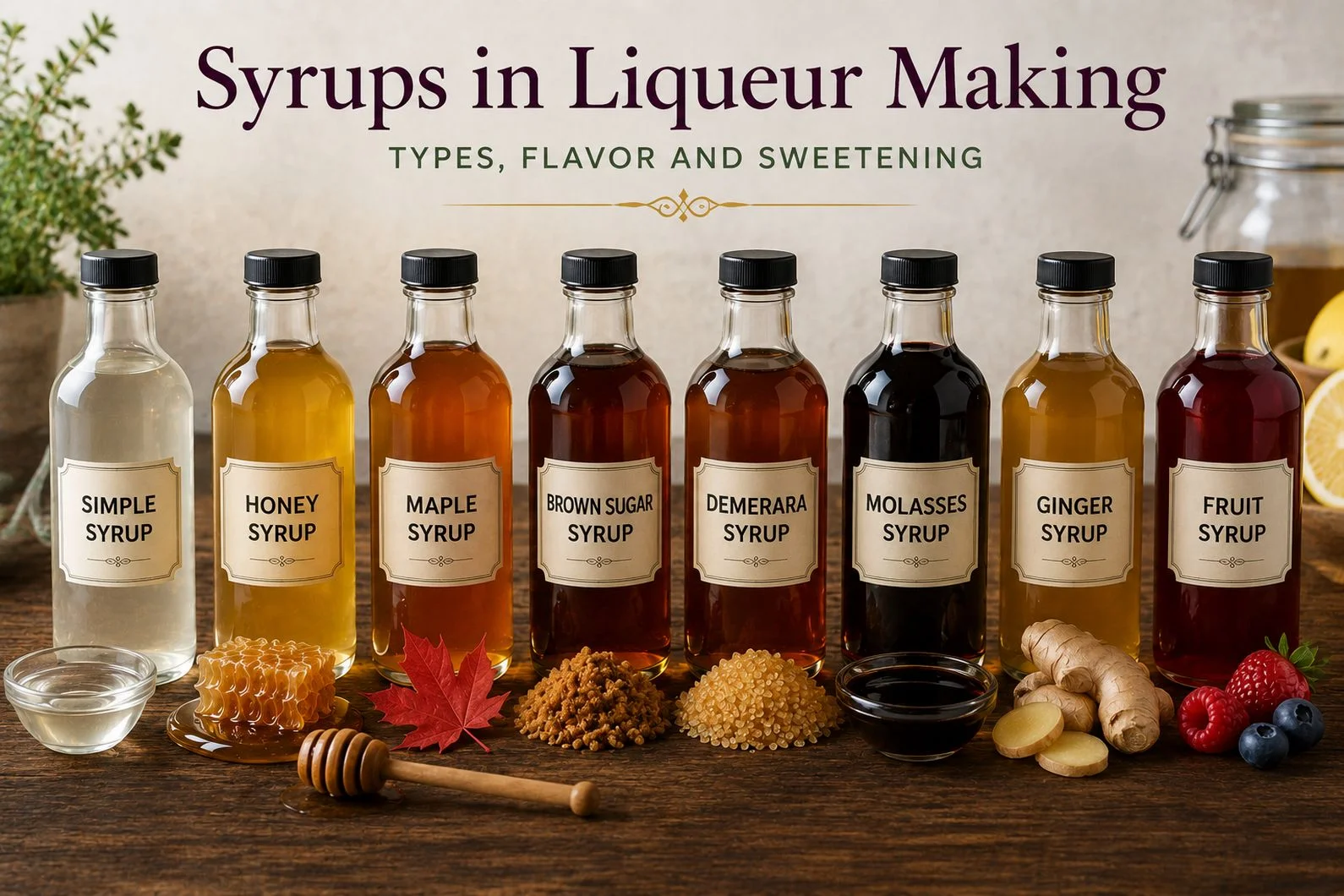
Different syrups can add sweetness, flavor, color and body while also influencing dilution and alcohol strength in homemade liqueurs.
Syrups in Liqueur Making
Syrups are one of the most practical ways to sweeten a liqueur because the sugar is already dissolved and can be incorporated evenly into an alcoholic infusion. They allow sweetness to be adjusted gradually and can simultaneously provide the water needed to reduce alcohol strength. Depending on the syrup, they may also contribute caramel, honey, fruit, spice, herbal or roasted flavours that become part of the finished liqueur.
Not all syrups are interchangeable. A simple syrup made from refined white sugar is relatively neutral, while demerara, honey, maple, golden syrup and molasses-based syrups can have substantial flavour and colour. Syrup concentration also matters. Two syrups may contain the same ingredients but different proportions of sugar and water, meaning that equal volumes will produce different sweetness, dilution and final alcohol strength.
For consistent liqueur making, syrups are best formulated by weight. Recording the grams of sugar and water used provides much greater precision than describing a syrup simply as "light" or "rich." When using commercial products such as maple or agave syrup, their existing water and sugar content should also be considered as part of the complete liqueur formulation.
Simple Syrup
Simple syrup is the most versatile syrup for liqueur making. It consists of refined sugar dissolved in water and contributes sweetness without introducing substantial additional flavour or colour. This makes it particularly suitable for delicate fruit, citrus, berry, floral and herbal liqueurs where the infused ingredients should remain dominant.
A common formulation is equal parts sugar and water. For accurate recipe development, these proportions should be measured by weight rather than volume. For example, 500 g of sugar combined with 500 g of water produces a repeatable syrup whose composition can be recorded and scaled easily.
Heat can accelerate dissolution, but prolonged boiling is unnecessary. Gentle heating while stirring is usually sufficient. Once the sugar has dissolved, allow the syrup to cool before blending it with the alcoholic infusion. This prevents unnecessary heating of volatile aromatic compounds in the liqueur.
Character: clean and neutral.
Best for: fruit, citrus, berry, floral and delicate botanical liqueurs.
Advantage: predictable sweetness and easy incorporation.
Consideration: the water in the syrup reduces the final alcohol concentration.
Rich Simple Syrup
Rich simple syrup contains a greater proportion of sugar relative to water than ordinary simple syrup. A commonly used formulation is approximately two parts sugar to one part water by weight. This creates a denser syrup that can deliver substantial sweetness while introducing less water into the liqueur.
This is particularly useful when the alcoholic infusion is already close to the desired final ABV or when a rich liqueur requires a high sugar concentration without excessive dilution. Rich syrup can work especially well in coffee, chocolate, nut, spice and dessert-style liqueurs, although it can also be made with neutral white sugar for more delicate recipes.
Because concentrated syrup is more viscous, it should be blended thoroughly. Add it incrementally rather than pouring the entire calculated quantity into the batch at once. The liqueur may require time after mixing before its final sweetness and texture can be judged accurately.
Standard simple syrup: more water, lighter concentration and greater dilution per gram of sugar delivered.
Rich simple syrup: more sugar relative to water and less dilution for the same quantity of added sugar.
Best use: high-sugar formulations where controlling added water is important.
Demerara Syrup
Demerara syrup is made by dissolving demerara sugar in water. In addition to sweetness, it contributes gentle caramel, toffee and cane-derived flavours together with a warm golden-to-amber colour. It offers considerably more character than white simple syrup without normally becoming as dominant as dark muscovado or molasses.
It works particularly well with orange, apple, pear, peach, apricot, pineapple, banana, coffee, nuts, vanilla and warming spices. Rum and brandy-based liqueurs are especially compatible because demerara's caramel character can complement flavours already present in these spirits.
Demerara syrup can be prepared at different concentrations depending on the required balance between sweetness and dilution. A rich demerara syrup is useful when substantial sweetness is required without adding excessive water. For lighter fruit liqueurs, blending demerara syrup with neutral simple syrup can provide more subtle caramel complexity.
Brown Sugar Syrup
Brown sugar syrup combines the sweetness of sucrose with molasses-derived flavours. Light brown sugar produces a relatively gentle caramel and toffee profile, while dark brown sugar can contribute stronger molasses, treacle and burnt-sugar characteristics.
This syrup is particularly suitable for apple, pear, plum, fig, raisin, banana, coffee, cacao, vanilla, cinnamon, clove and nut liqueurs. It can also work effectively with rum, brandy and whisky-based infusions where its darker flavour profile complements the base spirit.
Because brown sugar contains flavour and colour that refined sugar does not, it should be treated as a flavouring ingredient. A syrup that tastes pleasantly rich on its own may still overwhelm a delicate infusion. When uncertain, use a combination of brown sugar syrup and neutral simple syrup so that sweetness and molasses character can be controlled independently.
Cane Sugar Syrup
Cane sugar syrup is made from cane-derived sugar and can range from nearly neutral to distinctly caramelized or cane-like depending on the degree of refinement. A syrup prepared from refined white cane sugar behaves similarly to ordinary simple syrup, while less-refined cane sugars can contribute greater depth and colour.
It is particularly useful for tropical fruit and citrus liqueurs, including pineapple, mango, banana, orange and lime. Vanilla, ginger and warm spices also pair naturally with subtle cane flavours. Cane syrup is especially appropriate for rum-based liqueurs because both ingredients originate from sugar cane and often produce complementary flavour profiles.
Commercial cane syrups can vary considerably in sugar concentration. If a purchased syrup is used, check its ingredient declaration and nutritional information where possible. For reproducible recipes, calculate or record the amount of sugar delivered rather than relying only on the volume of syrup added.
Honey Syrup
Honey syrup is prepared by combining honey with water, making viscous honey much easier to measure, pour and incorporate into an alcoholic infusion. It retains the character of the original honey while allowing more precise incremental sweetening.
The flavour depends entirely on the honey used. Acacia honey syrup may be pale and delicately floral, orange blossom honey can contribute citrus-floral notes, while chestnut or buckwheat honey syrups can introduce dark, woody, malty or earthy characteristics. Honey syrup should therefore never be treated as a single standardized flavour.
Use only as much water as necessary for the intended formulation. A heavily diluted honey syrup may make blending easy but can lower the liqueur's ABV more than desired. Gentle warming can help combine honey and water, but unnecessary boiling should be avoided when preserving delicate honey aromas is important.
Select the honey: choose a variety that complements the infusion.
Weigh honey and water: record both quantities for accurate formulation.
Warm gently: use only enough heat to achieve complete mixing.
Cool before use: avoid adding hot syrup to a delicate aromatic infusion.
Bench test: honey flavour can become dominant before excessive sweetness is reached.
Maple Syrup
Maple syrup is both a sweetener and a powerful flavour ingredient. Genuine maple syrup contains water and naturally occurring sugars together with compounds responsible for its characteristic maple, caramel, woody and sometimes lightly toasted aromas.
It is particularly well suited to walnut, pecan, hazelnut, coffee, cacao, apple, pear, fig, vanilla and warming spice liqueurs. Whisky, bourbon-style spirits, aged rum and brandy can also form natural partnerships with maple flavours.
Maple syrup should not normally be substituted gram-for-gram for dry sugar without considering its water content. Adding a substantial quantity increases both sugar and water, thereby changing sweetness, volume and alcohol strength. Its pronounced flavour can also dominate subtle fruit or floral infusions.
For greater control, maple syrup can provide only part of the required sweetness while neutral sugar supplies the remainder. This allows the maple character to be adjusted independently from overall sweetness.
Agave Syrup / Agave Nectar
Agave syrup, often sold as agave nectar, is a concentrated sweetener derived from agave plants. It generally contains a high proportion of fructose, giving it substantial perceived sweetness and allowing relatively small quantities to have a noticeable sensory effect.
Light agave syrup has a fairly mild flavour and can be useful when a neutral-to-gently caramelized sweetener is required. Darker products may contribute stronger caramel and cooked flavours. Agave can pair well with citrus, tropical fruit, ginger, chilli, vanilla and some herbal infusions.
It is particularly interesting in liqueurs based on agave spirits, where the sweetener can support the character of the base alcohol. However, its high sweetness intensity means that direct substitution for sucrose should be tested rather than assumed. Add it incrementally and evaluate both sweetness and texture before scaling the formulation.
Golden Syrup
Golden syrup is a thick, amber-coloured sugar syrup with a distinctive buttery, caramelized and lightly toasted character. It usually contains a mixture of sugars, including sucrose and invert sugars, which gives it a smooth texture and helps resist crystallization.
Its flavour is well suited to apple, pear, fig, raisin, coffee, chocolate, vanilla, nuts and baking spices. It can also work in rum and brandy-based liqueurs where warm caramel notes support the spirit rather than compete with it.
Golden syrup is considerably more characterful than white simple syrup and can visibly darken pale liqueurs. For this reason, it is generally more appropriate for rich or dessert-oriented recipes than for delicate floral infusions.
A small proportion can also be combined with neutral syrup to provide caramel depth without making golden syrup the dominant flavour.
Molasses and Molasses-Based Syrups
Molasses is a concentrated by-product of sugar refining and contains intensely flavoured compounds that remain after sugar crystallization. Depending on the type, it can contribute treacle, burnt caramel, liquorice, mineral, roasted, bitter and slightly smoky characteristics. It is one of the most powerful sweetening ingredients available to a liqueur maker.
Because of this intensity, molasses is rarely an ideal direct replacement for all of the sugar in a liqueur. Small amounts can add impressive depth to coffee, cacao, walnut, pecan, raisin, fig, prune, vanilla and spice liqueurs. It is also particularly compatible with dark rum.
Blackstrap molasses is especially intense and can have pronounced bitterness and mineral character. It should be used with considerably greater restraint than lighter molasses. A practical technique is to incorporate a small amount into a neutral sugar syrup rather than using concentrated molasses alone.
Light molasses: sweeter and less intense, with caramel and treacle characteristics.
Dark molasses: stronger, deeper and more bitter.
Blackstrap: highly concentrated, mineral and distinctly bitter; use sparingly.
Best with: coffee, chocolate, nuts, dried fruit, spices and dark rum.
Fruit Syrups
Fruit syrups provide sweetness and fruit character simultaneously. They may be produced from fruit juice, concentrated juice, fruit purée or macerated fruit combined with sugar. This makes them useful for strengthening an existing fruit profile or introducing a complementary fruit after the main alcoholic extraction has been completed.
For example, raspberry syrup can intensify a berry liqueur, cherry syrup can add richness to a cherry or chocolate formulation, and concentrated citrus syrup can contribute both sweetness and fresh fruit character. Fruit syrups can also be used to create layered combinations such as blackberry and apple, peach and raspberry, or pear and elderberry.
The main challenge is formulation. Fruit syrup contributes water, natural fruit sugars, added sugar, acids, pigments, pectin and other fruit solids. These can change ABV, acidity, colour, clarity and stability. Pectin-rich syrups may produce haze, while fruit pulp can create sediment.
Whenever possible, record the weight of fruit, sugar and water used to make the syrup. Commercial fruit syrups should be evaluated for added flavourings, preservatives, colouring agents and their actual sugar concentration before use in a carefully formulated liqueur.
Spiced and Herbal Syrups
Spiced and herbal syrups allow flavour to be introduced during the sweetening stage rather than relying entirely on alcoholic maceration. Cinnamon, ginger, cardamom, vanilla, mint, rosemary and other aromatics can be infused into a sugar-and-water solution before the syrup is strained and added to the liqueur.
This technique provides an additional layer of extraction control because water and alcohol extract different groups of aromatic compounds with different efficiencies. A spice extracted in syrup may therefore produce a somewhat different profile from the same spice macerated in high-strength alcohol.
It is particularly useful when an alcoholic infusion is already satisfactory but needs a small secondary flavour adjustment. Instead of returning botanicals to the entire batch, a measured flavoured syrup can introduce both sweetness and the desired aromatic note.
Prepare the syrup: combine accurately weighed sugar and water.
Add the aromatic ingredient: use a controlled quantity of spice or herb.
Infuse carefully: monitor temperature and contact time to avoid excessive bitterness or cooked flavours.
Strain thoroughly: remove botanical material before blending.
Bench test: determine how much syrup provides the correct balance of sweetness and aroma.
Flavored Syrups and When to Use Them
A flavoured syrup can be used as a deliberate secondary flavour layer in liqueur formulation. In addition to fruit, herbs and spices, syrups can incorporate vanilla, coffee, cacao, tea, citrus zest, flowers and other culinary ingredients. This provides an alternative to extracting every ingredient directly in alcohol.
The technique is especially valuable when different components require different extraction conditions. A primary ingredient may benefit from several weeks of alcoholic maceration, while a delicate herb might need only a short water-based infusion. Preparing the second ingredient as part of the sweetening syrup allows the two extracts to be controlled separately before blending.
However, flavoured syrup should not become a way of hiding poor extraction. If the main infusion is weak, excessively bitter or unbalanced, adding numerous syrup flavours can make the recipe more complicated without solving the underlying problem. The strongest formulations generally give each ingredient a clear purpose.
Use flavored syrup when: an ingredient extracts better or differently in water than in strong alcohol.
Use it for adjustment: add a controlled secondary aroma after the primary maceration.
Use it for layering: combine complementary flavours without macerating them together.
Avoid unnecessary complexity: every additional flavour should improve the intended profile.
Comparing Syrups for Liqueur Making
The best syrup depends on the role it needs to perform. If the objective is simply to introduce sweetness and water while preserving the original infusion, white simple syrup is usually the most controllable choice. If additional caramel, honey, fruit or botanical character is desirable, a more expressive syrup can become part of the flavour architecture.
Syrups should be compared according to more than sweetness. Their water content affects dilution, their sugar composition affects perceived sweetness and texture, and their non-sugar components can influence colour, aroma, acidity and clarity. This is why equal volumes of two different syrups should never automatically be treated as equivalent.
Simple syrup: neutral, predictable and suitable for almost any liqueur.
Rich simple syrup: high sugar concentration with less water contribution.
Demerara syrup: gentle caramel and cane character.
Brown sugar syrup: deeper caramel and molasses notes.
Cane syrup: useful for tropical fruit, citrus and rum-based liqueurs.
Honey syrup: floral to intensely aromatic depending on the honey variety.
Maple syrup: woody, caramelized and particularly suitable for nuts, coffee and aged spirits.
Agave syrup: high perceived sweetness with relatively mild flavour in lighter varieties.
Golden syrup: smooth, buttery and caramelized.
Molasses syrup: extremely powerful, dark and potentially bitter.
Fruit syrup: adds sweetness, acidity, colour and additional fruit character.
Spiced or herbal syrup: useful for controlled secondary flavour extraction.
For advanced formulation, it is often useful to separate sweetness, dilution and flavour rather than expecting one syrup to control all three. A neutral syrup can provide most of the required sugar and water, while a smaller amount of maple, honey, demerara or another characterful syrup provides the desired aromatic contribution. This gives considerably more control over the final result.
Whatever syrup is chosen, accurate records are essential. Record the syrup's ingredients, sugar-to-water ratio, quantity added, starting infusion volume and final volume. With commercial syrups, also record the product or producer. This allows successful liqueurs to be reproduced and makes it possible to understand exactly how changes in syrup concentration affect sweetness, body, flavour and final alcohol strength.
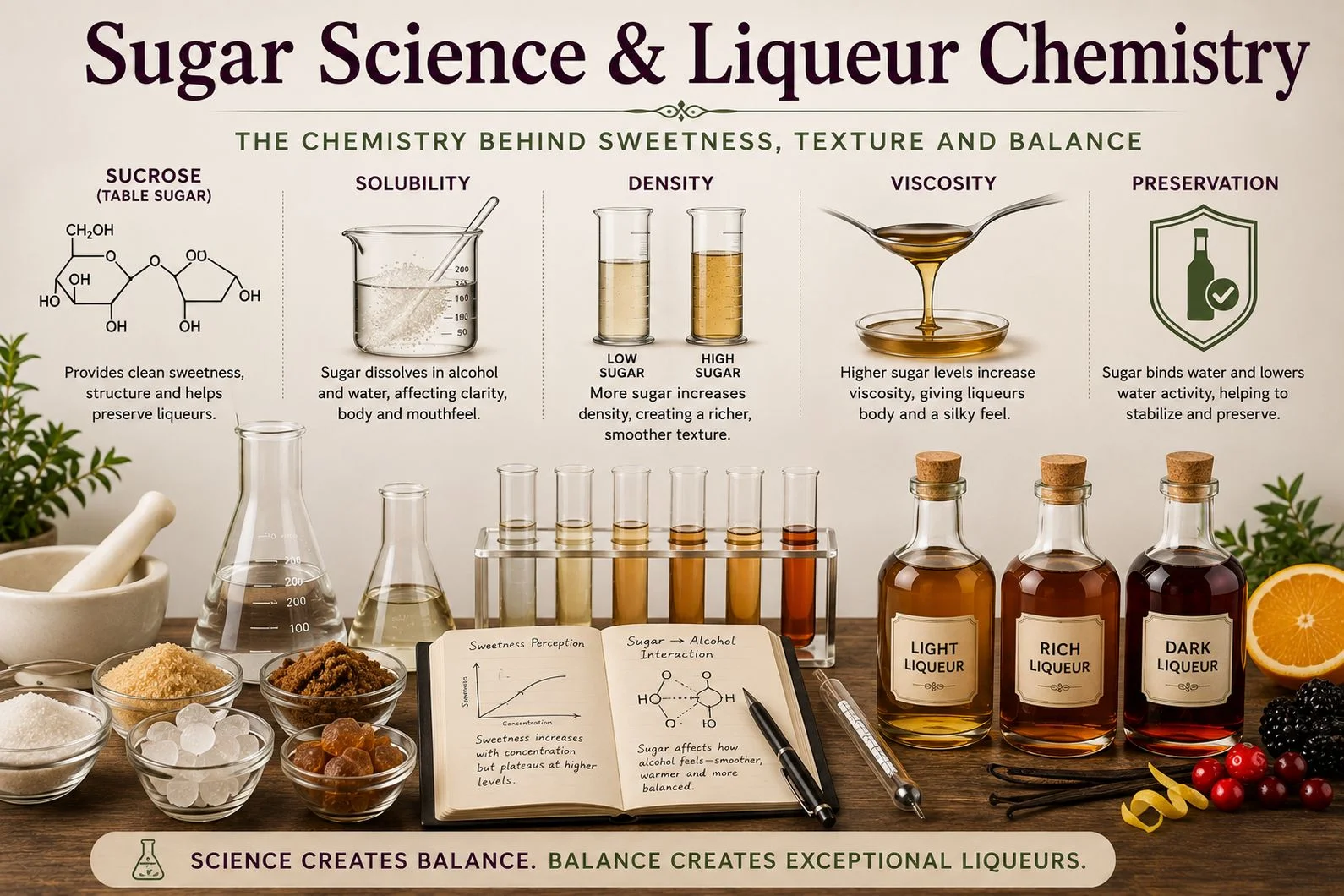
Understanding sugar chemistry helps control sweetness, solubility, density, texture and stability in homemade liqueurs.
Sugar Science & Liqueur Chemistry
Understanding the chemistry of sugar makes liqueur making more predictable. Sugar does not simply make alcohol taste sweeter: the type and concentration of sugars influence perceived sweetness, viscosity, density, crystallization, colour and the way acidity, bitterness, aroma and alcohol are experienced. Water and ethanol also affect how readily sugars dissolve and how the finished liqueur behaves during maturation and storage.
The chemistry does not need to be complicated to be useful. A few fundamental concepts explain many common observations: why sugar dissolves easily in water but poorly in very strong alcohol, why honey can taste different from an equivalent weight of white sugar, why concentrated syrup sometimes crystallizes and why two liqueurs containing different sweeteners can have noticeably different body even when their sweetness seems similar.
For advanced recipe development, understanding these relationships also improves repeatability. Recording sugar type, sugar mass, water addition, alcohol concentration, final volume and processing temperature provides much more useful information than simply recording that a batch was "sweetened to taste." The objective of sugar science is not to replace sensory judgement, but to explain what is happening so that successful results can be reproduced deliberately.
Sucrose, Glucose and Fructose: What Is the Difference?
Sucrose, glucose and fructose are three of the most important sugars encountered in liqueur making. Ordinary white table sugar consists primarily of sucrose. Glucose and fructose occur naturally in fruit and honey and are also produced when sucrose undergoes a process known as inversion.
Sucrose is a disaccharide, meaning that each molecule consists of two simpler sugar units joined together: one glucose unit and one fructose unit. When sucrose is hydrolysed, the bond between these units is broken and a mixture of glucose and fructose is produced. This resulting mixture is commonly called invert sugar.
The distinction matters because these sugars do not have identical sensory and physical properties. Fructose generally tastes sweeter than sucrose, while glucose generally tastes less sweet. Their solubility and crystallization behaviour also differ. Consequently, replacing sucrose with honey, invert syrup or another glucose-fructose-rich sweetener can change more than the total quantity of sugar in the recipe.
Sucrose: the principal sugar in ordinary white, cane and many brown sugars; provides familiar, clean sweetness.
Glucose: naturally present in fruit and honey; generally less sweet than sucrose.
Fructose: common in fruit and honey; generally sweeter than sucrose.
Invert sugar: a mixture rich in glucose and fructose produced by splitting sucrose.
For practical liqueur making, this means that grams of total sugar alone do not completely predict perceived sweetness. Sugar composition also matters, particularly when comparing sucrose syrup with honey, agave, invert syrup or fruit-derived sweeteners.
Relative Sweetness: Why Equal Amounts of Sweetener Do Not Taste Equally Sweet
Different sugars do not produce identical sweetness at equal concentrations. Sucrose is commonly used as a reference when comparing relative sweetness. Fructose generally produces greater perceived sweetness, while glucose generally produces less. However, relative sweetness is not a fixed number under every condition.
Temperature, concentration, acidity and the surrounding flavour matrix can all influence sweetness perception. A sugar dissolved in water may therefore be perceived somewhat differently when incorporated into a liqueur containing ethanol, fruit acids, bitter botanicals and aromatic compounds.
This is particularly important when substituting honey, agave syrup, invert syrup or fruit concentrates for ordinary sugar. A replacement based solely on equal weight may make the finished liqueur noticeably sweeter or less sweet than the original recipe.
Do not assume equal weight means equal perceived sweetness: sugar composition influences sweetness intensity.
Consider the complete recipe: acidity, bitterness and alcohol alter how sweetness is perceived.
Bench test substitutions: compare small samples before modifying the entire batch.
Taste at serving temperature: temperature can influence the sensory balance of the finished liqueur.
For advanced formulation, it is useful to distinguish between sugar concentration and perceived sweetness. Two liqueurs can contain similar quantities of sugars yet taste different because those sugars have different compositions and interact differently with acidity, bitterness and aroma.
Sugar Solubility in Alcohol and Water
Sucrose dissolves extremely well in water because water molecules interact strongly with the polar regions of the sugar molecule, allowing individual sugar molecules to separate from the crystal and disperse throughout the liquid. This is why ordinary sugar syrup is easy to prepare.
Sugar is much less soluble in ethanol than in water. An alcoholic spirit is not pure ethanol, so the water already present allows some sugar to dissolve, but dissolution becomes increasingly difficult as the proportion of ethanol rises. Adding a large quantity of dry sugar directly to a high-strength infusion can therefore result in crystals remaining at the bottom for a considerable time.
This explains why syrup is so effective in liqueur making. The sugar is dissolved in water first and the resulting solution is then blended with the alcoholic infusion. The additional water also reduces the overall ethanol concentration, creating an environment in which the sugar can remain dissolved more readily.
For easy incorporation: dissolve the sugar in water before adding it to a strong alcoholic infusion.
For minimal dilution: use a more concentrated syrup rather than unnecessarily large quantities of water.
When adding dry sugar: expect slower dissolution as alcohol strength increases.
Before bottling: confirm that all sugar has completely dissolved.
Temperature and Sugar Dissolution
Temperature has a major practical effect on sugar dissolution. Increasing the temperature of water generally allows sucrose to dissolve more readily and also increases the speed at which crystals enter solution. This is why warm water is commonly used when preparing simple or rich syrup.
However, boiling syrup for an extended period is usually unnecessary for liqueur making. Gentle heat is normally sufficient to dissolve the sugar. Excessive heating evaporates water, which changes the intended sugar-to-water ratio, and can eventually introduce cooked or caramelized flavours that may not suit a delicate liqueur.
Heat should be used particularly carefully when making honey, fruit, flower or herb syrups. Many desirable aromatic compounds are volatile, and prolonged heating can reduce their freshness. In these cases, the objective is usually to use enough heat to achieve dissolution or extraction without unnecessarily cooking the ingredients.
Warm water: speeds sugar dissolution.
Gentle heating: is normally sufficient for ordinary liqueur syrups.
Prolonged boiling: can evaporate water and alter syrup concentration.
Aromatic syrups: benefit from restrained temperatures when fresh aromas need to be preserved.
Sugar Inversion and Why It Matters
Sugar inversion occurs when sucrose is hydrolysed into glucose and fructose. The reaction can be encouraged by acid, heat or specific enzymes. In practical syrup making, heating sucrose in the presence of an acid can gradually produce an invert-sugar mixture.
Inversion matters because glucose and fructose behave differently from intact sucrose. An invert syrup can have a different sweetness profile and is generally less prone to sucrose crystallization. This makes invert sugar particularly useful in highly concentrated syrups and rich liqueurs where crystallization could otherwise become a problem.
Some inversion can also occur naturally in acidic formulations over time. Fruit-based liqueurs commonly contain organic acids such as citric or malic acid, so their sugar chemistry may slowly change during storage, although the extent depends strongly on conditions.
For most homemade liqueurs, deliberately producing invert syrup is optional rather than essential. Ordinary sucrose syrup works extremely well in a wide range of recipes. Invert sugar becomes especially useful when very high sugar concentrations, smooth texture or resistance to crystallization are important.
Crystallization: Why It Happens and How to Prevent It
Crystallization occurs when dissolved sugar molecules reorganize into an ordered solid crystal structure. It is most likely when a solution contains more dissolved sucrose than can comfortably remain in solution under the prevailing conditions. This can happen in highly concentrated syrups, particularly after cooling.
Small crystals or undissolved sugar particles can provide nucleation sites from which larger crystals grow. Agitation of a supersaturated solution can sometimes encourage this process. Water loss through excessive boiling can also increase sugar concentration beyond the intended level and make crystallization more likely.
Invert sugar, glucose and fructose can interfere with the orderly formation of sucrose crystals, which is one reason invert syrups are useful in concentrated sweet products. In practical liqueur making, however, accurate syrup ratios and avoiding unnecessary concentration are usually the first lines of prevention.
Measure accurately: weigh sugar and water instead of estimating quantities.
Avoid unnecessary boiling: water evaporation can make syrup more concentrated than intended.
Dissolve completely: avoid leaving undissolved crystals in the finished syrup.
Use invert sugar when appropriate: it can reduce crystallization in highly concentrated formulations.
Check stored bottles: crystals appearing later can indicate that the formulation was close to its solubility limit.
Sugar, Viscosity and Liqueur Body
As dissolved sugar concentration increases, a liqueur generally becomes more viscous. In sensory terms, this creates greater body, weight and coating of the palate. This physical change is a major reason that a properly sweetened liqueur can feel smoother and more substantial than the original unsweetened alcoholic infusion.
Viscosity affects the entire drinking experience. A relatively dry liqueur can feel light and spirit-like, while a highly sweetened formulation can become dense and syrupy. Increased viscosity can also make alcohol heat seem less aggressive because the liquid feels softer and fuller in the mouth.
The appropriate viscosity depends on style. A fresh lemon, raspberry or elderflower liqueur may benefit from relatively restrained body, while coffee, chocolate, nut and dessert liqueurs can support much greater richness. Excessive viscosity can suppress freshness and make a liqueur tiring to drink even if its individual flavours are pleasant.
Advanced liqueur makers should therefore evaluate sugar additions in two dimensions: How sweet does the liqueur taste? and How does the liqueur physically feel? The best sugar concentration should satisfy both.
Sugar and Density
Density describes how much mass is contained within a particular volume. Dissolving sugar in a liquid increases its mass and usually increases its density. Consequently, a heavily sweetened liqueur is generally denser than an unsweetened spirit or lightly sweetened infusion.
This has practical consequences for measurement. Instruments calibrated for simple alcohol-and-water mixtures can give misleading alcohol readings when substantial sugar is present because dissolved sugar changes density. A hydrometer reading taken after sweetening therefore cannot automatically be interpreted in the same way as a reading from an unsweetened fermentation or simple spirit-water solution.
Density can nevertheless be useful when developing repeatable liqueurs. If the same recipe is produced consistently, measurements of mass, volume and density can help identify differences between batches. Commercial and advanced producers may use more sophisticated methods to determine alcohol and sugar concentrations accurately in complex solutions.
More dissolved sugar: generally means greater liquid density.
Greater density: does not necessarily mean greater sweetness when different sugars are being compared.
Alcohol measurement: simple density-based readings become harder to interpret after sugar is added.
Recipe control: record sugar mass and final volume rather than trying to infer everything from a post-sweetening hydrometer reading.
Sugar and Color Development
Pure refined sucrose contributes very little colour when simply dissolved in water under normal syrup-making conditions. A clear white-sugar syrup therefore allows the natural pigments of fruit, flowers, herbs and spices to remain visually dominant.
Colour becomes more complicated when unrefined sugars are used. Demerara, brown sugar, muscovado, jaggery, coconut sugar and molasses contain coloured compounds originating from their raw materials and processing. These can shift a liqueur toward gold, amber, reddish-brown or deep brown.
Heat can create additional colour through caramelization when sugars are exposed to sufficiently high temperatures. This is different from simply dissolving sugar in warm water. Normal syrup preparation does not require intentional caramelization unless a cooked caramel flavour and darker colour are specifically desired.
Another important distinction is the Maillard reaction. This involves reducing sugars reacting with amino compounds and is responsible for many browned and roasted flavours in foods. It should not be confused with caramelization, which involves thermal changes to sugars themselves. In ordinary liqueur sweetening, neither reaction needs to be significant unless ingredients are deliberately heated strongly.
Sugar, Oxidation and Flavor Stability
Oxidation is an important part of liqueur maturation and deterioration. Oxygen can react with compounds extracted from fruit, herbs, spices and other ingredients, potentially changing colour and aroma over time. Some controlled evolution may create a more integrated flavour, but excessive oxidation can reduce freshness and produce dull, stale or browned characteristics.
It is tempting to describe sugar as a universal preservative against oxidation, but the relationship is more complicated. The sugar concentrations found in ordinary liqueurs do not simply stop oxidative reactions. Stability depends on the complete formulation, including alcohol concentration, pH, oxygen exposure, light, temperature and the chemical composition of the infused ingredients.
Honey and unrefined sweeteners add another layer of complexity because they contain compounds beyond pure sugar. These may contribute antioxidants, minerals, organic acids and reactive flavour compounds. Their effect on long-term stability therefore cannot be predicted from sugar concentration alone.
Limit oxygen exposure: store finished liqueurs in well-sealed bottles with appropriate fill levels.
Protect from light: light can accelerate deterioration of some natural pigments and aromas.
Monitor delicate liqueurs: floral, fresh-fruit and brightly coloured infusions may show changes sooner than robust dark liqueurs.
Sugar and Shelf Stability
High sugar concentrations can inhibit microbial growth by reducing water activity, which is why very concentrated jams and syrups can be relatively stable. However, it is unsafe to assume that any sweet liqueur is automatically preserved simply because it contains sugar. The protective effect depends on how much sugar is present, how much available water remains, the alcohol concentration, acidity and other factors.
Alcohol is another major contributor to stability, but again the complete formulation matters. Adding large quantities of low-concentration syrup, fruit juice or fruit purée can significantly reduce the final ABV. A liqueur that began as a strong alcoholic infusion may therefore have very different stability after sweetening and dilution.
Fresh fruit syrups, dairy ingredients, eggs, cream and other perishable additions require additional care and should not be treated like a conventional spirit-based fruit or herbal liqueur. Their storage requirements and shelf life can be substantially different.
For ordinary homemade fruit, herb and spice liqueurs, good sanitation, clean bottles, controlled formulation and appropriate storage are essential. Never rely on sweetness alone as evidence that a product is microbiologically stable.
Start clean: sanitize bottles, closures and equipment appropriately.
Know what was added: record alcohol, water, sugar, juice and other ingredients.
Consider final ABV: remember that syrup and juice can substantially dilute the original spirit.
Store appropriately: protect the liqueur from excessive heat, light and oxygen.
Treat perishable recipes separately: cream, dairy, egg and similar liqueurs require different storage considerations.
The central lesson of sugar chemistry is that sweetness cannot be considered in isolation. Sugar type, concentration, water, alcohol, temperature, acidity and storage conditions all interact. Understanding these relationships allows the liqueur maker to move beyond simply adding sugar until a drink tastes sweet enough and instead design sweetness, texture, dilution and stability as deliberate parts of the finished liqueur.
A balanced liqueur brings sweetness, acidity, bitterness, tannins and alcohol together without allowing any one element to dominate.
Balancing a Liqueur
Balancing a liqueur means bringing sweetness, acidity, bitterness, tannin, aroma, alcohol and texture into a relationship where none of them overwhelms the others. A technically well-extracted infusion can still taste incomplete if its sweetness is too low, too high or poorly matched to the other components. Conversely, a modest infusion can become much more expressive once the correct balance is achieved.
There is no universal sugar level that works for every style. A bright citrus liqueur may need enough sweetness to soften acidity while remaining fresh, whereas a walnut or coffee liqueur may require a richer texture and greater sweetness to balance bitterness and roasted intensity. The correct level depends on the ingredients, alcohol strength, serving temperature and intended style of the finished drink.
The most reliable approach is to balance in stages. Rather than sweetening the entire batch immediately, prepare small measured samples and compare several sugar concentrations. This allows sweetness to be judged alongside acidity, bitterness, tannin, alcohol heat and aroma, and gives the liqueur maker a much clearer understanding of how each adjustment changes the finished profile.
Finding the Right Sweetness Level
The correct sweetness level is the point at which the liqueur tastes integrated rather than simply sweet. Too little sugar can leave alcohol, acidity or bitterness exposed, while too much can flatten aroma, reduce freshness and create a heavy finish. The aim is to find the lowest level of sweetness that delivers the intended balance and mouthfeel.
Bench testing is one of the best tools for finding this point. Divide the infusion into several equal samples and sweeten each to a slightly different concentration. Taste them side by side after they have rested and cooled to the temperature at which the liqueur will normally be served.
Prepare equal samples: use the same volume of infusion in each glass or bottle.
Create a sweetness range: increase sugar gradually from one sample to the next.
Rest the samples: allow the sugar and alcohol to integrate before tasting.
Compare the whole profile: assess aroma, sweetness, acidity, bitterness, texture and finish together.
Choose the most balanced sample: not necessarily the sweetest one.
Advanced makers can refine this process by keeping written tasting notes and recording sugar in grams per litre. This makes future batches much easier to reproduce and allows deliberate adjustments when fruit acidity or ingredient intensity changes from season to season.
Balancing Sweetness Against Acidity
Sweetness and acidity are two of the strongest opposing forces in fruit liqueurs. Acid creates brightness, freshness and structure, while sugar softens sharpness and makes fruit taste riper and more generous. A successful liqueur usually contains enough of both to remain lively without becoming either sour or cloying.
High-acid fruits such as lemon, sour cherry, cranberry, currant and some berries can require substantial sweetness, but simply adding more sugar is not always the best solution. Excessive sugar can eventually produce a syrupy liqueur while the underlying acidity still feels aggressive. In such cases, the formulation itself may need adjustment.
Likewise, a low-acid liqueur can taste flat even when the sweetness level appears correct. A small amount of appropriate acidity can sharpen flavour and reduce the perception of excessive sweetness without removing any sugar.
Too acidic: increase sweetness gradually and reassess after resting.
Too sweet and flat: carefully increasing acidity may restore freshness.
Fruit liqueurs: aim for a balance where acidity supports freshness rather than dominating the palate.
Delicate styles: avoid using sugar to completely suppress natural fruit brightness.
Balancing Sweetness Against Bitterness
Bitterness is common in liqueurs containing citrus peel, coffee, cacao, herbs, roots, bark and certain spices. In moderate amounts it adds complexity and length, but excessive bitterness can make a liqueur harsh or medicinal. Sweetness is one of the main tools used to soften this perception.
The important distinction is between balancing bitterness and hiding over-extraction. If a botanical infusion contains an appropriate amount of bitterness, sugar can round the edges and make the flavour more harmonious. If the infusion is severely over-extracted, however, adding large amounts of sugar may simply create a liqueur that is both too sweet and too bitter.
For bitter styles, it is often useful to test several sugar levels while keeping the infusion itself unchanged. This reveals whether the bitterness is structurally useful or genuinely excessive. Darker sweeteners can sometimes reinforce bitter or roasted flavours, while neutral white sugar can soften them without adding additional complexity.
Balanced bitterness: should contribute complexity and a clean finish.
Excessive bitterness: usually indicates extraction or dosage problems that sweetness alone cannot solve.
Neutral sugar: is useful when you want to soften bitterness without adding new flavours.
Dark sugars: can work well with coffee, cacao and dark botanicals, but may also intensify roasted impressions.
Balancing Sweetness Against Tannins and Astringency
Tannins contribute dryness, structure and astringency rather than simple bitterness. They are common in ingredients such as tea, grape skins, some berries, nuts, bark and certain woody botanicals. Astringency is the drying or puckering sensation created when tannins interact with proteins in the mouth.
Sugar can reduce the perceived harshness of tannin and give the liqueur a fuller, smoother texture, but it does not remove tannins from the liquid. If extraction has produced an aggressively drying result, excessive sweetening may only partially conceal the problem.
Tannic liqueurs often benefit from both sweetness and time. Resting can allow flavours to integrate and some harsh edges to soften. A richer mouthfeel from sugar can also make a moderate tannin level feel more structured rather than rough.
Moderate tannin: can add useful structure and length.
Too much astringency: suggests reducing extraction time or ingredient dosage in future batches.
Sweetness: can soften perception but does not chemically remove tannins.
Resting: can improve integration and reduce the impression of harshness.
Balancing Sweetness Against Alcohol Heat
Alcohol contributes warmth, aroma transport and structure, but at high concentrations it can also feel sharp or burning. Sugar can reduce the perceived intensity of this heat by increasing sweetness and viscosity, making the liqueur feel rounder and softer.
This sensory effect should be distinguished from actual alcohol reduction. Adding dry sugar may soften the perception of alcohol without dramatically reducing the ABV, while adding syrup lowers the ABV because additional water is introduced.
If a liqueur remains aggressively alcoholic even after reaching an appropriate sweetness level, the problem may be that the final alcohol concentration is too high for the intended style. In that case, controlled dilution may be more appropriate than adding further sugar.
Perceived heat: can often be softened with sweetness and increased body.
Actual ABV: is lowered only by increasing the proportion of non-alcoholic liquid.
Do not over-sweeten: excessive sugar should not be used to compensate for an unnecessarily high final ABV.
Resting matters: alcohol integration often improves after bottling and maturation.
Choosing Sweeteners to Match Fruits
Fruit liqueurs benefit from sweeteners that support the natural character of the fruit rather than obscure it. Light, aromatic fruits such as pear, peach, apricot and many citrus varieties often work best with neutral or gently flavoured sweeteners. Dark berries, plums, figs and dried fruits can support richer sugars and honeys.
White sugar is usually the safest starting point because it allows the fruit to remain dominant. Acacia honey, light cane sugar or mild simple syrup can add subtle complexity without taking over. Darker sweeteners should be used when the fruit itself has enough depth to support caramel, molasses or earthy notes.
Citrus: white sugar, light cane sugar, orange blossom honey or light agave.
Pear and peach: white sugar, acacia honey or mild cane sugar.
Berries: white sugar, wildflower honey, demerara or light brown sugar depending on intensity.
Plum and fig: demerara, brown sugar, honey or small amounts of muscovado.
Tropical fruit: cane sugar, coconut sugar, palm sugar or agave can work particularly well.
For advanced blending, use a neutral sugar for most of the sweetness and a smaller amount of characterful sweetener for complexity. This is often more precise than using a strong sugar or honey as the sole sweetener.
Choosing Sweeteners to Match Herbs and Flowers
Herbal and floral liqueurs can be particularly sensitive to the choice of sweetener. Many flowers and delicate herbs produce subtle aromas that are easily overshadowed by molasses, caramel or strongly flavoured honey.
For elderflower, rose, chamomile, jasmine and other delicate botanicals, white sugar, acacia honey or another pale, mild sweetener is generally the best starting point. Linden honey can be particularly interesting with selected herbal preparations because of its own floral and herbal character.
More assertive herbs such as rosemary, thyme, sage and some bitter botanicals can support stronger sweeteners, but the match should still be deliberate. A dark sugar may create an earthy, medicinal or savoury impression that is either desirable or distracting depending on the style.
Delicate flowers: favour neutral or very light sweeteners.
Fresh herbs: use mild sweeteners unless a darker style is intentionally desired.
Bitter botanicals: can support richer sweetness, but avoid compounding bitterness with overly dark sweeteners.
Honey: choose floral varieties whose aroma complements rather than competes with the botanicals.
Choosing Sweeteners to Match Spices
Spices usually tolerate more assertive sweeteners than delicate fruits or flowers. Cinnamon, clove, ginger, cardamom, nutmeg and vanilla all pair naturally with caramelized sugars, honey and dark syrups. These combinations can produce warm, rich and layered liqueurs.
Demerara, brown sugar, muscovado, jaggery and palm sugar are especially useful where the goal is depth and warmth. Honey can provide a softer aromatic character, while white sugar keeps the spice profile cleaner and more transparent.
Not all spice liqueurs need to be dark. Fresh ginger, cardamom or citrus-spice combinations can remain bright and elegant when paired with neutral sugar. The sweetener should reflect the intended style rather than simply the intensity of the spice.
Warm baking spices: demerara, brown sugar, jaggery and honey are strong matches.
Fresh ginger: works with white sugar, cane sugar, honey or agave.
Vanilla: pairs with almost every sugar type, from white sugar to muscovado.
Cardamom and floral spices: often benefit from lighter sugars that preserve aromatic lift.
Choosing Sweeteners to Match Nuts, Coffee, Chocolate and Roasted Ingredients
Nut, coffee, cacao and roasted liqueurs are among the best candidates for dark and characterful sweeteners. Their naturally deep flavour profiles can support caramel, molasses, malt and toasted notes that would overwhelm more delicate ingredients.
Demerara, brown sugar, muscovado, maple syrup, golden syrup, chestnut honey and buckwheat honey can all add complexity. Coffee and cacao can also work with small quantities of molasses, provided its bitterness and mineral character are carefully controlled.
Because these ingredients are often already bitter or roasted, sweetness should be used to create body and soften harsh edges without erasing the underlying character. Dark sweeteners can reinforce roast, but too much can make the liqueur heavy, burnt or muddy.
Coffee: demerara, brown sugar, maple syrup, muscovado or buckwheat honey.
Chocolate and cacao: brown sugar, muscovado, golden syrup or dark honey.
Walnut and hazelnut: demerara, maple syrup, chestnut honey or brown sugar.
Roasted ingredients: dark sweeteners can reinforce depth, but should be balanced against bitterness.
Light vs Dark Sweeteners: When Each Works Best
Light sweeteners are best when the goal is clarity, freshness and ingredient definition. White sugar, refined cane sugar, acacia honey and light syrups contribute sweetness with relatively little additional flavour or colour. They are particularly useful for citrus, pale fruit, flowers and delicate herbs.
Dark sweeteners contribute more than sweetness. Muscovado, jaggery, dark brown sugar, molasses, maple syrup and robust honeys can add caramel, treacle, malt, earthiness and roasted flavours. They are therefore better suited to dark fruit, spices, nuts, coffee, cacao and aged-spirit liqueurs.
The choice does not need to be absolute. Many excellent liqueurs use a combination of both. Neutral sugar can establish the required sweetness level while a smaller proportion of dark sweetener provides flavour and colour.
Choose light sweeteners when: preserving freshness, colour and delicate aroma is the priority.
Choose dark sweeteners when: caramel, molasses, roasted or earthy complexity is desirable.
Blend both when: you want rich flavour without allowing the sweetener to dominate.
Always bench test: the darker and more aromatic the sweetener, the more important small-scale trials become.
Successful balance comes from treating sweetness as part of the entire flavour structure rather than as a separate final adjustment. The right sweetener should support acidity, bitterness, tannin, alcohol and aroma while contributing an appropriate level of body. Once these elements work together, the liqueur feels complete rather than merely sweet.
Practical techniques help you measure, sweeten, bench test, adjust and mature homemade liqueurs with greater consistency and control.
Practical Liqueur-Making Techniques
Sweetening becomes much easier and more consistent when it is treated as a measured stage of liqueur making rather than an improvised final adjustment. The practical objective is to determine how much sugar the infusion needs, introduce it without unnecessary dilution, evaluate the result after integration and keep enough records to reproduce the successful formulation.
For most new recipes, the safest approach is to complete the main alcoholic extraction first and sweeten the strained infusion afterward. This separates extraction from balancing and allows several sugar concentrations to be tested without risking the entire batch. It also makes problems such as excessive bitterness, acidity or tannin easier to identify before sweetness begins masking them.
The techniques below apply to white sugar, syrups, honey and many alternative sweeteners, although their sweetness intensity, water content and flavour contribution must be considered individually. Accurate weighing, small-scale testing and patience after blending are the foundations of reliable sweetening.
How Much Sugar Should You Add per Litre?
There is no single quantity of sugar that is correct for every liqueur. The amount required depends on the ingredient, natural fruit sugar, acidity, bitterness, alcohol strength, intended texture and style. A bright citrus or floral liqueur may taste best with relatively restrained sweetness, while coffee, walnut, bitter botanical or dessert-style liqueurs may require considerably more.
As a practical starting framework for recipe development, approximately 100-200 g of added sugar per litre produces a relatively lightly sweetened style, 200-300 g/L moves into a more recognisably sweet liqueur profile, and 300-400 g/L or more can create a rich, full-bodied style. These are formulation ranges rather than rules. Fruit already containing substantial natural sugar or recipes using honey and sweet syrups require additional consideration.
100-200 g/L: useful experimental range for lighter, fresher and relatively dry styles.
200-300 g/L: a useful starting range for many conventional fruit and botanical liqueurs.
300-400 g/L: produces greater richness and body and can suit tart fruit, coffee, nuts and dessert-style liqueurs.
400+ g/L: creates a very rich style and should be used deliberately rather than assumed to be necessary.
The most important principle is to use these ranges as starting points for testing rather than fixed recipes. A lemon infusion and a raspberry infusion containing 250 g/L of added sugar may taste very different because their acidity, natural sugars, aromatic compounds and bitterness are different.
Calculating Sugar for a Target Sweetness
Working in grams per litre makes sugar calculations straightforward and recipes easy to scale. If you know the desired concentration and the amount of liqueur being prepared, the required sugar can be calculated from those two values.
For example, if you have 750 ml of infusion and want to test an addition equivalent to 200 g of sugar per litre, the required quantity is 150 g. For 1.5 litres at the same rate, the corresponding amount would be 300 g.
This simple calculation is most useful when comparing recipes based on added sugar. It should not be confused with an analytical measurement of the total sugar concentration of the finished liqueur, because fruit, honey, syrups and other ingredients may already contain sugars.
When syrup is used, calculate how much actual sugar the syrup contains. Adding 300 g of syrup does not necessarily mean adding 300 g of sugar because part of the syrup is water. The same principle applies to honey, maple syrup, agave and commercial fruit syrups.
How to Sweeten a Finished Infusion Gradually
A finished infusion should normally be sweetened incrementally. Once excessive sugar has been added, removing it is difficult; adding a little more is easy. Gradual addition also reveals how the flavour changes as sweetness increases.
First measure the volume of the strained infusion and decide whether you are adding dry sugar, syrup, honey or another sweetener. Prepare the sweetener consistently and record its composition. Add only part of the estimated requirement, mix thoroughly and allow it to integrate before deciding whether more is necessary.
Measure the infusion: record the exact volume before sweetening.
Choose the sweetener: consider both sweetness and its contribution to flavour, colour and water content.
Start conservatively: add less than the estimated final requirement.
Mix completely: ensure the sweetener is evenly distributed before tasting.
Allow integration: do not make every adjustment immediately after the previous addition.
Repeat in small increments: stop when additional sweetness no longer improves the balance.
Record the final quantity: this becomes the starting formulation for the next batch.
Bench Testing: Finding the Best Sweetness Before Sweetening the Whole Batch
Bench testing is one of the most useful techniques in serious liqueur making. Instead of experimenting with an entire litre or several litres of infusion, divide a small quantity into equal samples and sweeten each one differently. This makes the effect of sugar concentration immediately comparable and dramatically reduces the risk of ruining a batch.
For example, prepare five 50 ml samples of the same infusion. Leave one unsweetened and adjust the others to progressively higher equivalent sugar concentrations. The exact range should reflect the style of liqueur being developed. Taste the samples side by side rather than sequentially modifying one glass.
Evaluate more than sweetness. Look for changes in fruit expression, acidity, bitterness, alcohol heat, aroma, viscosity and finish. Frequently, the preferred sample is not the sweetest one. It is the concentration at which the other flavours become most coherent.
Use identical samples: 30-50 ml per sample is normally sufficient for testing.
Change one variable: keep everything except sugar concentration identical.
Label every sample: record the equivalent sugar concentration or exact amount added.
Rest before judging: freshly mixed samples can taste different after several hours or days.
Compare at serving temperature: temperature affects sweetness and aroma perception.
Scale mathematically: once the preferred sample is identified, calculate the corresponding addition for the full batch.
Correcting an Overly Sweet Liqueur
An overly sweet liqueur is more difficult to correct than an under-sweetened one because dissolved sugar cannot simply be removed. This is why gradual sweetening and bench testing are so valuable. Nevertheless, an excessively sweet batch can often be rescued by changing the balance or increasing the quantity of unsweetened liquid.
The cleanest correction is usually blending with more of the same unsweetened infusion. This reduces sugar concentration while maintaining a similar flavour profile. If additional infusion is unavailable, an appropriate spirit-and-water mixture may be used, but this also changes flavour intensity and alcohol concentration and should therefore be tested on a small sample first.
Increasing acidity can make excessive sweetness seem less dominant, particularly in fruit liqueurs, but acidity should not be used simply to fight an extreme sugar overdose. The result can become simultaneously too sweet and too acidic. Bitter components can similarly change perceived balance without actually removing sugar.
Best correction: blend with additional unsweetened infusion where possible.
Alternative: carefully dilute with an appropriate spirit-and-water mixture.
Acidity adjustment: useful for fine balancing, not for correcting severe over-sweetening.
Before correcting the batch: test the proposed adjustment on a small measured sample.
Correcting an Under-Sweetened Liqueur
An under-sweetened liqueur is comparatively easy to correct. If acidity, bitterness or alcohol remains too prominent, additional sweetener can be introduced gradually until the desired balance is reached.
Before adding sugar, identify what actually seems wrong. A liqueur may appear insufficiently sweet because it is unusually acidic, strongly bitter or very high in alcohol. Increasing sugar may improve the result, but it is useful to understand which component is being balanced.
Add small measured quantities and keep a running total. When syrup is used, remember that each addition also introduces water and lowers the ABV. When honey, maple, demerara or another characterful sweetener is used, each addition changes flavour as well as sweetness.
Taste analytically: identify whether acidity, bitterness, tannin or alcohol is creating the imbalance.
Add a measured quantity: avoid unrecorded splashes of syrup or spoonfuls of sugar.
Mix completely: uneven distribution makes tasting unreliable.
Rest and retaste: give the adjustment time to integrate.
Stop when balanced: do not continue simply because the liqueur could physically dissolve more sugar.
What to Do When Sugar Will Not Dissolve
Sugar dissolves readily in water but much less readily in ethanol. If dry sugar is added directly to a high-strength alcoholic infusion, dissolution can therefore be surprisingly slow. Large crystals such as rock sugar and mishri take even longer because they have less surface area relative to their mass.
The simplest solution is usually to dissolve the sugar separately in a measured quantity of water and add the resulting syrup to the infusion. If dilution needs to be minimized, prepare a concentrated syrup rather than using a large amount of water.
Gentle agitation can help when only a small quantity remains undissolved, but shaking indefinitely will not overcome an unsuitable solvent composition. Warmth can also assist dissolution, although directly heating an alcoholic liqueur is unnecessary and introduces avoidable safety and aroma concerns. Prepare the syrup separately instead.
Use syrup: dissolve sugar in water before introducing it to strong alcohol.
Use smaller crystals: granulated sugar dissolves faster than large rock sugar.
Mix thoroughly: gentle agitation improves contact between sugar and liquid.
Avoid directly heating high-proof alcohol: prepare and cool the syrup separately.
Preventing Sediment and Cloudiness After Sweetening
A previously clear infusion can become cloudy after sweetening. This does not necessarily mean that the liqueur has spoiled. Changing the alcohol-water-sugar balance can alter the solubility of compounds extracted from fruit, peel, spices and botanicals. Materials that remained dissolved in a stronger alcoholic solution may become less soluble after syrup reduces the alcohol concentration.
Honey, jaggery, unrefined sugars, fruit syrups and some dark sweeteners can also introduce fine particles, proteins, minerals, pectin or other materials that refined white sugar does not. These may create haze or settle as sediment during maturation.
One of the best preventative techniques is to allow the liqueur to rest after sweetening before final filtration and bottling. If haze is going to develop, it is better for it to appear in the maturation vessel than in the finished bottle. Chilling can sometimes encourage unstable material to precipitate and settle, making subsequent filtration more effective.
Filter the infusion first: remove fruit and botanical particles before sweetening.
Use clean syrup: ensure sugar is fully dissolved and filter characterful syrups if necessary.
Sweeten and rest: give newly formed haze time to appear and settle.
Cold-condition if appropriate: chilling may help some insoluble material precipitate.
Filter again: perform final polishing only after the liqueur has stabilized.
Resting and Maturation After Adding Sweetener
A liqueur should not necessarily be considered finished the moment the sugar dissolves. Immediately after sweetening, alcohol, sweetness, acidity and aroma can seem more separate than they do after a period of rest. Over time, the sensory profile often becomes more integrated and rounded.
The required resting period depends on the liqueur. A simple fruit infusion may settle into balance relatively quickly, while complex spice, nut, coffee or botanical liqueurs can continue evolving for weeks or months. The objective is not to follow an arbitrary maturation period but to monitor how the profile develops.
Resting also gives suspended material time to settle and reveals whether the sweetened formulation remains physically stable. This is particularly useful before final filtration and presentation bottling.
Short rest: useful before making final sweetness adjustments.
Several weeks: can significantly improve integration in many fruit and botanical liqueurs.
Long maturation: can benefit complex nut, spice, coffee and dark-fruit styles.
Keep tasting notes: compare the liqueur at consistent intervals rather than relying on memory.
Why a Liqueur's Sweetness Changes After Resting
The amount of sugar in a properly sealed liqueur does not normally change dramatically simply because the bottle rests, but the perception of sweetness can change considerably. This is an important distinction. A liqueur that seems slightly sharp immediately after blending may appear smoother and sweeter several days later even though no additional sugar has been added.
This happens because sweetness is experienced as part of a larger sensory system. Alcohol heat, acidity, bitterness, aroma and texture all affect how sweet a drink seems. As the liqueur rests and these characteristics become better integrated, the relative prominence of sweetness can shift.
Serving temperature also matters. If a newly mixed sample is tasted warm and the matured liqueur is later tasted chilled, the comparison is not controlled. For accurate recipe development, evaluate samples under similar conditions.
Some fruit-based liqueurs may also undergo gradual chemical changes during maturation, including changes in aroma compounds, pigments and sugar composition. These can subtly alter flavour perception even though the total amount of carbohydrate has not meaningfully changed.
Do not finalize immediately: avoid making repeated large sugar adjustments in a single tasting session.
Rest the liqueur: give a major sweetening adjustment time to integrate.
Taste under consistent conditions: use similar temperature, glassware and serving quantities.
Record your observations: note how the perceived sweetness changes over several days or weeks.
Make the final adjustment last: once the liqueur has settled, make only the small correction required to reach the intended balance.
The practical rule is simple: measure, test, add gradually and allow time before making the next decision. This approach prevents most sweetening problems and produces recipes that can be repeated rather than recreated by guesswork. For beginners it provides a reliable method; for advanced liqueur makers it creates the data needed to refine sugar concentration, ABV, texture and flavour with much greater precision.
Avoiding common sweetening mistakes helps preserve flavor, control dilution and achieve better balance in homemade liqueurs.
Common Sweetening Mistakes
Many problems in homemade liqueurs occur during sweetening rather than extraction. A well-made fruit, herb or spice infusion can quickly become unbalanced if too much sugar is added, the wrong sweetener is chosen or the water contained in syrup is ignored. Because sweetness also changes the perception of acidity, bitterness, alcohol and aroma, an apparently simple adjustment can affect the entire liqueur.
Most sweetening mistakes are easier to prevent than correct. Sugar can always be added later, but removing dissolved sugar is difficult. Similarly, a strongly flavoured honey or dark syrup cannot be separated from the infusion once it has been blended. Small-scale testing, accurate measurements and adequate resting time therefore provide much greater control than sweetening entirely by intuition.
The following mistakes are particularly common when developing new recipes. Understanding why they happen makes it easier to diagnose an unbalanced liqueur and, more importantly, prevents the same problem in future batches.
Adding Too Much Sugar Too Early
Adding the full quantity of sugar at the beginning is one of the easiest ways to lose control of a liqueur. The final sweetness requirement cannot always be predicted accurately before extraction is complete because fruits, herbs, spices and other ingredients contribute different amounts of natural sugar, acidity, bitterness and tannin.
Early sugar addition can also make sensory evaluation more difficult. Sweetness suppresses or softens the perception of acidity, bitterness and alcohol heat. A heavily sweetened infusion may therefore appear balanced even though the underlying extraction is excessively bitter or tannic.
For most experimental recipes, a more controllable method is to complete the alcoholic extraction, strain the infusion and evaluate it unsweetened. Sugar or syrup can then be introduced gradually. This allows the amount of sweetness to respond to the actual character of the infusion rather than an estimate made several weeks earlier.
Problem: excessive sweetness is difficult to reverse.
Additional risk: sugar can mask extraction problems during tasting.
Better approach: reserve most or all sweetening until the main extraction is complete.
For established recipes: early sweetening can be used deliberately when the behaviour of the ingredients is already well understood.
Using Strong-Flavored Sweeteners That Overpower the Infusion
Dark sugars, molasses, maple syrup, muscovado, jaggery and strongly aromatic honeys can add impressive complexity, but they can also become more noticeable than the ingredient the liqueur was originally intended to showcase. This is particularly problematic with delicate fruits, flowers and herbs.
A pear infusion, for example, may have a subtle fresh aroma that is easily overwhelmed by dark molasses notes. Likewise, a delicate elderflower liqueur can lose its floral definition if sweetened heavily with buckwheat or chestnut honey. The resulting drink may still taste pleasant, but its flavour identity has fundamentally changed.
The safest technique is to separate sweetness from flavour intensity. Use a neutral sweetener such as white sugar for most of the required sweetness and introduce a smaller amount of the characterful sweetener for complexity. This allows the aromatic contribution to be controlled independently.
Taste the infusion first: identify how delicate or robust its primary aroma is.
Taste the sweetener separately: consider its caramel, floral, earthy, roasted or bitter characteristics.
Bench test the combination: determine how much can be added before the original ingredient loses definition.
Blend sweeteners if necessary: use neutral sugar for sweetness and a smaller quantity of strong sweetener for flavour.
Ignoring the Water Added by Syrups and Honey
Sweetening ingredients are not always pure sugar. Simple syrup contains substantial water, honey naturally contains water, and commercial maple, agave and fruit syrups contain varying proportions of sugars and water. Adding them therefore changes more than sweetness.
The water introduced by a syrup increases the total volume and reduces the final alcohol concentration. This may be desirable when the liqueur needs both sweetening and dilution, but it becomes a problem when the water contribution has not been included in the formulation.
Honey deserves particular attention because it is often treated as though it were simply liquid sugar. In reality, its moisture content varies, and its glucose and fructose composition also means that its perceived sweetness does not exactly match sucrose. A recipe converted from dry sugar to honey therefore requires more consideration than a simple equal-weight substitution.
Dry sugar: adds sugar with very little direct water contribution.
Simple syrup: contributes both sugar and a substantial amount of water.
Honey: contributes sugars, water, aroma, acids and other minor components.
Commercial syrups: vary in concentration and should be evaluated individually.
For accurate recipe development, record the weight of both sugar and water entering the formulation rather than recording only the total amount of syrup.
Accidentally Diluting the Liqueur Too Much
Excessive dilution often occurs when a relatively weak syrup is used to deliver a large quantity of sugar. Every addition may seem small, but repeated adjustments can introduce enough water to reduce the final ABV substantially and weaken the flavour intensity of the infusion.
Suppose a liqueur requires considerable sweetness but only modest alcohol reduction. A concentrated rich syrup can deliver the required sugar using less water than a standard simple syrup. Alternatively, some formulations can use dissolved dry sugar where appropriate, although dissolution becomes more difficult in strong alcohol.
Dilution is not inherently undesirable. Most liqueurs require some combination of sugar and water to reach their intended style. The mistake is allowing dilution to happen accidentally rather than designing it as part of the recipe.
Know the starting ABV: record the strength and volume of the alcoholic component.
Determine the desired final strength: decide how much dilution is appropriate.
Choose the syrup concentration: use the water addition as part of the formulation.
Track every addition: include water from syrup, juice, honey and other ingredients.
Check the final volume: do not assume it remains equal to the original infusion volume.
Sweetening Before Evaluating Acidity and Bitterness
Sweetness, acidity and bitterness strongly influence one another. Sugar reduces the perception of sourness and bitterness, which is useful when balancing a liqueur but can make diagnosis difficult if the infusion is sweetened before it has been evaluated properly.
Taste the strained infusion before adding sugar. Determine whether its acidity is refreshing or aggressive, whether bitterness contributes useful complexity or indicates over-extraction, and whether tannins are providing structure or excessive astringency.
If the unsweetened infusion is extremely bitter, simply adding more sugar may create a liqueur that is simultaneously very bitter and excessively sweet. Similarly, an extremely acidic infusion can require so much sugar for apparent balance that freshness is replaced by syrupy heaviness.
Evaluate acidity: determine whether it provides freshness or excessive sharpness.
Evaluate bitterness: distinguish desirable complexity from over-extraction.
Evaluate tannin: identify drying astringency separately from bitterness.
Then sweeten: use sugar to create balance rather than conceal a fundamentally flawed extraction.
Judging Sweetness Before the Liqueur Has Rested
A freshly sweetened liqueur can taste noticeably different after several hours, days or weeks. Although the amount of sugar may remain essentially unchanged, the perception of sweetness changes as alcohol, acidity, bitterness, aroma and texture become better integrated.
A common mistake is to add sugar, taste immediately, decide that the liqueur is still too dry and add more. Repeating this several times in one session can result in substantial over-sweetening. By the time the liqueur has rested, it may taste considerably richer than intended.
This is especially important after major adjustments. Small final corrections can often be evaluated relatively quickly, but a substantial syrup addition deserves more time. Complex herbal, spice, nut and dark-fruit liqueurs may continue changing for considerably longer.
Mix thoroughly: make sure the sweetener is completely distributed.
Allow time: avoid repeatedly making large adjustments in one tasting session.
Retaste consistently: compare the liqueur at a similar serving temperature.
Make small final corrections: once the balance has stabilized, adjust only what is necessary.
Keeping tasting notes is particularly valuable. Recording impressions immediately after sweetening and again several days later helps reveal how a particular recipe develops and makes future batches easier to formulate.
Choosing the Wrong Sweetener for Delicate Ingredients
Delicate ingredients require sweeteners that preserve aromatic definition. Pear, white peach, elderflower, jasmine, chamomile, rose and many fresh herbs can produce elegant but relatively subtle infusions. Strong caramel, molasses, earthy or roasted sweeteners can easily obscure these characteristics.
White sugar is often the most effective choice for delicate liqueurs precisely because it contributes so little flavour of its own. Refined cane sugar, acacia honey and other mild sweeteners can provide alternatives where slightly more character is desired without fundamentally changing the infusion.
Colour is another consideration. A dark sugar may not only change flavour but also turn a pale golden or almost colourless infusion brown. If visual freshness is important, a light sweetener generally provides greater control.
Delicate fruit: start with white sugar, refined cane sugar or mild honey.
Flowers: favour clean, pale sweeteners that preserve floral aroma.
Fresh herbs: avoid dark caramel flavours unless they are intentionally part of the design.
Strong sweeteners: introduce them in small proportions and compare against a neutral control sample.
The best way to avoid sweetening mistakes is to treat sugar as a controllable ingredient rather than an automatic final addition. Measure what enters the batch, understand whether it contributes water and flavour, test unfamiliar sweeteners on small samples and allow the liqueur time to settle before making the final decision. These habits require very little additional work but provide substantially greater control over sweetness, ABV, clarity, texture and flavour.
Choose a sweetener that complements the ingredients, flavor intensity, color and style of your homemade liqueur.
Choosing the Best Sweetener
Choosing the best sweetener for a liqueur is not simply a question of deciding how sweet the finished drink should be. The sweetener can influence aroma, flavour, colour, viscosity, clarity, dilution and perceived alcohol heat. A neutral sugar allows the infused ingredients to remain dominant, while honey, dark sugar, maple syrup, molasses and other characterful sweeteners can become important flavour ingredients in their own right.
The best choice therefore depends on the intended style. Delicate flowers and pale fruits generally benefit from clean, light sweeteners, while coffee, nuts, cacao, spices and dark fruits can support much richer sugars and syrups. There are also situations where combining sweeteners gives better control than relying on a single ingredient.
For beginners, refined white sugar is usually the most predictable starting point. Advanced liqueur makers can then use alternative sweeteners to deliberately modify aroma, body and complexity. Whatever the choice, small-scale testing remains the most reliable way to determine whether a sweetener improves the infusion rather than simply making it sweeter.
Best Sweeteners for Clear and Delicate Liqueurs
Clear and delicate liqueurs require sweeteners that interfere as little as possible with aroma and colour. Refined white sugar is usually the first choice because it provides clean sweetness, dissolves predictably and contributes virtually no colour or additional flavour.
Refined cane sugar can perform a similar role. Acacia honey is another option when a very gentle floral character is desirable, although even pale honey contributes more aroma and potentially more haze than refined sugar. Light agave syrup can also work in some recipes but should be tested carefully because its sugar composition produces a different sweetness profile.
White sugar: the most neutral and predictable option.
Refined cane sugar: similarly clean when highly refined.
Acacia honey: useful for subtle floral complexity.
Light agave: relatively mild but potentially sweeter gram-for-gram than sucrose-based formulations.
Avoid strongly coloured sugars unless their flavour is intentionally part of the recipe. Even a small amount of molasses, muscovado or dark honey can dramatically change the appearance and aromatic profile of a pale liqueur.
Best Sweeteners for Fruit Liqueurs
Fruit liqueurs offer the widest range of sweetener choices because different fruits vary enormously in acidity, tannin, natural sugar and aromatic intensity. White sugar remains the most versatile choice because it allows the fruit to determine the flavour profile.
Pear, peach, apricot, melon and other delicate fruits generally benefit from neutral or lightly aromatic sweeteners. Plum, fig, banana and dried fruits can support demerara, brown sugar, honey and other richer alternatives. Tropical fruits can pair particularly well with cane sugar, coconut sugar, palm sugar and agave.
Delicate fruits: white sugar, refined cane sugar or acacia honey.
Stone fruits: white sugar, honey, demerara or light brown sugar.
Dark fruits: demerara, brown sugar, wildflower honey or small amounts of muscovado.
Dried fruits: brown sugar, muscovado, jaggery, dark honey or golden syrup.
When developing a new fruit liqueur, start with a neutral sweetener as a control. Alternative sugars can then be tested against it. This makes it much easier to determine whether the additional flavour genuinely improves the fruit.
Best Sweeteners for Citrus Liqueurs
Citrus liqueurs usually depend on fresh aromatic oils, acidity and, where peel is used, some degree of bitterness. The sweetener should soften these elements without obscuring the bright citrus character.
White sugar is the classic choice because it preserves freshness and colour. Refined cane sugar is similarly effective. Orange blossom honey can work particularly well with orange, mandarin and lemon because its floral character naturally reinforces citrus aromas. Light agave may also suit modern citrus formulations.
Demerara can be useful when creating a darker orange or spiced citrus liqueur, particularly with rum or brandy. Muscovado and molasses are considerably more dominant and are normally better reserved for deliberately dark, rich citrus styles.
Lemon: white sugar, refined cane sugar or mild honey.
Orange and mandarin: white sugar, cane sugar or orange blossom honey.
Grapefruit: neutral sugar is useful for controlling bitterness without adding competing flavours.
Spiced citrus: demerara, honey or light brown sugar can provide additional depth.
Best Sweeteners for Berry Liqueurs
Berries often combine strong colour with acidity, tannin and concentrated aroma, allowing them to support a wider range of sweeteners than delicate pale fruits. White sugar provides the cleanest expression, while honey and less-refined sugars can add depth.
Raspberry and strawberry generally benefit from relatively light sweeteners if their fresh aroma is the priority. Blackberry, blackcurrant, bilberry and elderberry can support demerara, wildflower honey and modest quantities of darker sugar because their flavour is sufficiently intense.
Strawberry: white sugar, cane sugar or mild floral honey.
Raspberry: white sugar, acacia honey or light wildflower honey.
Blackberry: white sugar, demerara, wildflower honey or light brown sugar.
Blackcurrant: white sugar, demerara or aromatic honey.
Bilberry and elderberry: demerara, honey and selected darker sugars can work well.
Berry acidity should always be considered when comparing sweeteners. The best choice is not necessarily the one that tastes sweetest, but the one that produces the best relationship between fruit intensity, acidity, tannin and body.
Best Sweeteners for Floral Liqueurs
Flowers produce some of the most delicate aromas used in liqueur making. Their volatile floral compounds can easily be overwhelmed by caramel, molasses, malt or strongly earthy flavours, making neutral sweeteners particularly valuable.
White sugar is generally the safest choice for elderflower, rose, jasmine, chamomile, lavender and other floral liqueurs. Acacia honey can add gentle floral depth, while orange blossom honey can work when citrus and blossom characteristics are already part of the intended profile.
Linden honey is particularly interesting in selected botanical formulations because its floral and herbal qualities can reinforce rather than simply sweeten the infusion. Nevertheless, honey should be bench tested because even floral honey may become more prominent than the flowers themselves.
Best neutral option: white sugar.
For gentle honey character: acacia honey.
For citrus-floral styles: orange blossom honey.
For herbal-floral complexity: carefully tested linden honey.
Best Sweeteners for Herbal and Botanical Liqueurs
Herbal and botanical liqueurs range from fresh and aromatic to intensely bitter, making sweetener selection highly dependent on style. A mint or lemon balm liqueur may need clean sweetness, while a complex root-and-bark formulation can support considerably darker sugars.
White sugar is ideal when botanical definition is important. Honey can complement floral and herbal aromas, particularly when its botanical character matches the infusion. Demerara and brown sugar are better suited to robust herbs, roots and warming botanical combinations.
Bitter herbal liqueurs require particular care. Dark sugar can add attractive depth but may also reinforce earthy, burnt or bitter characteristics. Using neutral sugar for most of the sweetness and a smaller amount of characterful sweetener often provides better control.
Fresh herbs: white sugar, cane sugar or mild honey.
Floral botanicals: white sugar, acacia honey or linden honey.
Roots and bark: demerara, brown sugar, honey or carefully controlled darker sugars.
Bitter formulations: start with neutral sugar before introducing additional dark flavours.
Best Sweeteners for Spiced Liqueurs
Spiced liqueurs can support some of the most characterful sweeteners. Cinnamon, clove, nutmeg, vanilla, ginger and similar ingredients naturally complement caramel, honey, molasses and less-refined sugar flavours.
Demerara is an excellent general-purpose choice because it provides depth without the intensity of muscovado. Brown sugar, jaggery and palm sugar can create richer styles, while honey provides a softer aromatic character. White sugar remains useful when the objective is a clean, spice-forward liqueur rather than a dark dessert-style drink.
Cinnamon and clove: demerara, brown sugar, honey or jaggery.
Ginger: white sugar, cane sugar, honey or agave.
Vanilla: white sugar for clarity or dark sugar for dessert-style richness.
Cardamom: white sugar or mild honey preserves its aromatic freshness.
Complex warming spice blends: demerara, palm sugar, jaggery or controlled amounts of muscovado.
Best Sweeteners for Nut, Coffee and Chocolate Liqueurs
Nut, coffee and chocolate liqueurs are naturally compatible with rich sweeteners because roasted flavours can support caramel, toffee, molasses, maple and dark honey characteristics. The challenge is usually not whether these flavours work together, but how much complexity the liqueur can support before it becomes heavy.
Demerara and brown sugar are excellent starting points. Muscovado can provide deeper molasses notes, while maple syrup works especially well with walnut and pecan. Chestnut and buckwheat honeys can add earthy complexity to robust recipes. Golden syrup provides smooth caramel character without the intensity of molasses.
Coffee: demerara, brown sugar, muscovado, maple or dark honey.
Cacao and chocolate: brown sugar, demerara, golden syrup or muscovado.
Walnut: demerara, maple syrup or chestnut honey.
Hazelnut: demerara, brown sugar, maple or golden syrup.
Roasted nuts: characterful sugars work particularly well, but excessive molasses can dominate.
Sweetener Substitutions and Conversion Ratios
Sweetener substitutions should not be treated as exact one-to-one replacements unless the ingredients have similar sugar concentration and composition. Dry sucrose is almost entirely sugar, while honey, maple syrup and agave contain water. Simple syrup contains even more deliberately added water. Equal weights therefore deliver different quantities of sugar and produce different levels of dilution.
A useful calculation is to estimate the actual sugar supplied by the replacement. If 100 g of a syrup contains 65 g of sugars, approximately 154 g of that syrup would be required to deliver 100 g of sugar equivalents by mass. This does not guarantee identical perceived sweetness because the types of sugar may differ, but it provides a more rational starting point than direct substitution.
Replacement required = desired sugar mass ÷ sweetener sugar fraction
For example, a sweetener containing 80% sugars has a sugar fraction of 0.80. To supply 100 g of sugars, approximately 125 g of that sweetener would be required. The remaining approximately 25 g consists primarily of water and other components and must also be considered when calculating dilution.
Dry white sugar: use as the reference for neutral sucrose sweetness.
Honey: contains water and predominantly glucose and fructose; exact composition varies.
Maple syrup: contains substantial water and contributes characteristic flavour.
Agave: often contains a high proportion of fructose and can produce greater perceived sweetness.
Simple syrup: calculate from the actual sugar-to-water ratio used.
For commercial sweeteners, nutritional information can provide a useful estimate of sugar content. For homemade syrups, weighing the ingredients during preparation provides much better control. After the mathematical conversion, always perform a sensory test because equivalent sugar mass does not necessarily produce equivalent flavour or perceived sweetness.
Sweetener Comparison Chart
The following comparison provides a practical starting point for selecting sweeteners. Individual products vary, particularly honey, palm sugar, jaggery and minimally refined sugars, so the actual ingredient should always be tasted before use.
Sweetener
Flavor Impact
Color Impact
Best Uses
Main Consideration
White Sugar
Very low
Very low
Fruit, citrus, flowers, herbs
Best general-purpose neutral sweetener
Demerara Sugar
Mild caramel and toffee
Light amber
Dark fruit, spice, nuts, coffee
Adds depth without extreme molasses character
Brown Sugar
Caramel and molasses
Amber to brown
Apple, plum, coffee, cacao, spice
Can overpower delicate ingredients
Muscovado
Strong molasses, treacle and malt
Dark
Coffee, chocolate, nuts, dried fruit
Very characterful; often best blended with neutral sugar
Honey
Varies from delicate floral to dark and earthy
Pale to dark amber
Fruit, flowers, herbs, spices
Varietal flavour and water content vary
Maple Syrup
Maple, caramel, woody and toasted
Amber
Nuts, coffee, chocolate, aged-spirit liqueurs
Adds both water and strong flavour
Agave Syrup
Low to moderate
Low to amber
Citrus, tropical fruit, ginger
High fructose content can affect perceived sweetness
Golden Syrup
Buttery caramel
Golden amber
Nuts, coffee, chocolate, dried fruit
More characterful than simple syrup
Jaggery / Palm Sugar
Caramel, earthy, malty and complex
Golden to dark brown
Tropical fruit, spices, dark spirits
Composition and flavour vary significantly
Molasses
Very strong treacle, roasted and bitter
Very dark
Coffee, cacao, nuts, dark rum
Use sparingly
Final Sweetening Checklist for Homemade Liqueurs
Before considering a liqueur finished, evaluate the complete formulation rather than sweetness alone. A final checklist helps prevent last-minute adjustments from creating problems with ABV, clarity, flavour or texture.
Evaluate the unsweetened infusion: understand its acidity, bitterness, tannin and alcohol intensity.
Choose the sweetener deliberately: decide whether it should be neutral or contribute flavour.
Bench test: compare several sweetness levels before modifying the whole batch.
Measure by weight: record sugar, honey, syrup and water accurately.
Account for dilution: include water from syrups, honey, juice and other additions.
Add gradually: it is easier to increase sweetness than remove it.
Mix thoroughly: ensure the batch is homogeneous before evaluating it.
Allow it to rest: do not judge the final balance immediately after a major adjustment.
Check clarity: allow haze or sediment to develop before final filtration.
Retaste at serving temperature: evaluate the liqueur under realistic drinking conditions.
Record the final recipe: note quantities, final volume and observations for the next batch.
Conclusion: Using Sugar Science to Build Better Liqueurs
Sweetening is one of the most important stages of liqueur making because it connects extraction with the final drinking experience. Sugar changes more than sweetness: it influences viscosity, density, perceived acidity, bitterness, alcohol heat and the way aromas are experienced. Syrups introduce water and therefore affect dilution, while honey and less-refined sweeteners contribute additional flavours, colours and physical characteristics.
The most useful principle is to separate the different jobs a sweetener may perform. Ask whether the recipe needs more sweetness, more body, lower alcohol strength, additional flavour or some combination of these. Once those objectives are clear, the appropriate sugar, honey or syrup becomes much easier to choose.
Neutral white sugar remains invaluable because it provides control. Characterful sweeteners such as demerara, muscovado, honey, maple, jaggery and molasses become most effective when they are selected for a specific flavour purpose rather than simply because they are alternatives to white sugar.
Accurate measurements make this creative process repeatable. Record the quantity and type of sweetener, water additions, infusion volume and final volume. When experimenting, change one variable at a time and use small bench trials before scaling the preferred formulation.
Finally, allow time to become part of the recipe. A freshly sweetened liqueur is not always an accurate representation of the finished drink. Resting allows sweetness, alcohol, acidity, bitterness and aroma to become better integrated and gives haze or sediment time to appear before final filtration.
Understanding sugar science does not remove creativity from liqueur making. It provides the opposite: greater control over the creative decisions. Once you understand how different sugars behave and how sweetness interacts with the rest of the formulation, you can move beyond simply making an infusion sweeter and begin designing its balance, texture, aroma and finish deliberately.
FAQ - Frequently Asked Questions
White granulated sugar is usually the best all-purpose sugar for homemade liqueurs because it provides clean, predictable sweetness without adding a strong flavor of its own. That makes it especially useful when you want fruit, herbs, flowers, spices or other infused ingredients to remain the main focus. Refined white sugar is almost pure sucrose, dissolves readily when made into syrup and has very little effect on the color of the finished liqueur. For beginners, it is also easier to measure and reproduce from batch to batch than many less-refined alternatives.
The main advantage of white sugar is control. Because it is neutral, you can evaluate the infusion itself before deciding whether the recipe needs additional caramel, molasses, floral or earthy notes. More characterful sugars such as demerara, brown sugar, muscovado, jaggery or honey can be excellent, but they should be chosen because their flavor improves the recipe rather than simply because they are available. In delicate pear, peach, citrus, floral and herbal liqueurs, a strongly flavored sweetener can easily overpower the primary ingredient.
A practical method is to use white sugar as the baseline sweetener when developing a new recipe. Bench test several sugar levels, record the amount used per litre and only then experiment with replacing a small proportion with honey or darker sugar if greater complexity is desired. This approach separates sweetness from flavor and gives much better control over the final balance.
For most homemade liqueurs, adding sugar after the main infusion is complete gives the greatest control. When fruit, herbs, spices or botanicals are first macerated in alcohol without much added sugar, you can evaluate the extraction more clearly. Once the solids are strained out, you can judge acidity, bitterness, tannin, alcohol heat and aroma before deciding how much sweetness is actually needed. This is particularly useful when developing a new recipe because natural fruit sugar and extraction intensity can vary considerably between batches.
Sugar can also be added before or during infusion, and traditional recipes sometimes use this method successfully. Sugar draws water from fruit through osmotic effects and can influence how quickly juices and flavor compounds move into the surrounding liquid. However, early sweetening can make it harder to identify over-extraction because sweetness softens the perception of bitterness, acidity and alcohol. It also commits the batch to a sweetness level before you know exactly how the infusion will develop.
A reliable approach for experimental recipes is to extract first, strain, then sweeten gradually using measured additions or bench tests. Once a recipe has been repeated several times and its behavior is predictable, adding sugar earlier can become a deliberate stylistic choice rather than a gamble. Whichever method you choose, record when the sugar was added, how much was used and whether it was dry sugar or syrup, because timing can influence both extraction and final balance.
Neither dry sugar nor simple syrup is universally better; each solves a different formulation problem. Dry sugar adds sweetness with very little direct water, which is useful when you want to preserve a relatively high alcohol strength. However, sucrose dissolves much more easily in water than in ethanol, so dry sugar can dissolve slowly in a strong alcoholic infusion. Large crystals may settle at the bottom for a long time, especially when the liqueur contains relatively little water.
Simple syrup solves the dissolution problem by dissolving the sugar in water before it is added to the alcohol. This makes sweetening gradual, predictable and easy to mix. The trade-off is dilution. Every gram of water in the syrup increases the final volume and lowers the alcohol percentage. A standard syrup made with equal weights of sugar and water adds much more water than a rich syrup made with roughly two parts sugar to one part water, so syrup concentration matters when designing the final strength of the liqueur.
Use syrup when easy mixing and controlled dilution are priorities. Use dry sugar, or a very concentrated syrup, when you need sweetness with minimal additional water. For accurate results, weigh both sugar and water rather than measuring by spoons or cups. Advanced makers should treat sweetness and dilution as separate variables: calculate how much sugar the liqueur needs, how much water it can accept, and then choose the delivery method that fits both targets.
Honey can replace some or all of the sugar in a homemade liqueur, but it should not be treated as an exact one-to-one substitution. White sugar is almost pure sucrose, while honey contains mostly fructose and glucose together with water, organic acids, minerals and aromatic compounds. These differences affect perceived sweetness, dilution, aroma, color and texture. A liqueur sweetened with honey will therefore usually taste different even when the total amount of sugar is similar.
The variety of honey matters just as much as the quantity. Acacia honey is pale and mild and can work well with flowers, citrus and delicate fruit. Orange blossom honey reinforces citrus and floral aromas, while chestnut, buckwheat and heather honeys are much darker and more assertive. Strong honey can easily overpower pear, peach, jasmine or elderflower, but it may be excellent with nuts, coffee, dark berries, herbs and aged spirits. Honey can also introduce haze or sediment because it contains more than simple dissolved sugars.
The safest method is to bench test honey before sweetening the entire batch. Start by replacing only part of the white sugar, allowing neutral sugar to provide most of the sweetness while honey contributes aroma and complexity. If the honey is difficult to mix, gently loosen it with a small measured amount of warm water rather than boiling it. Record both the honey weight and any added water so you can account for the final dilution and reproduce the recipe accurately.
A liqueur can become cloudy after syrup is added because sweetening changes the balance between alcohol, water and dissolved compounds. Many oils, pigments and aromatic substances extracted from citrus peel, herbs, spices or other botanicals remain soluble in a relatively strong alcoholic solution. When syrup introduces water and lowers the alcohol concentration, some of those compounds may no longer remain fully dissolved. They can form a fine haze even though the liqueur was perfectly clear before sweetening.
The sweetener itself can also contribute to cloudiness. Honey, fruit syrups, jaggery, molasses and minimally refined sugars can contain fine particles, proteins, minerals, pectin or other natural material. These may remain suspended after blending and later settle as sediment. In fruit liqueurs, pectin can be particularly important, while citrus infusions may develop an oil-related haze when diluted. Cloudiness is therefore not automatically a sign of spoilage, although unusual gas production, mold, off odors or unexpected fermentation require separate investigation.
To reduce the problem, filter the alcoholic infusion well before sweetening and make sure the syrup is completely dissolved. After adding the syrup, allow the liqueur to rest before final bottling so haze has time to develop and solids can settle. Chilling may help some unstable material precipitate. The liqueur can then be carefully racked or filtered again. For future batches, record the syrup concentration and final dilution because a smaller water addition may sometimes preserve better clarity.
A liqueur can taste sweeter after resting even when no additional sugar has been added because perceived sweetness depends on the entire sensory balance, not only the number of grams of sugar present. Immediately after blending, alcohol heat, acidity, bitterness and sharp aromatic notes can be more obvious. These sensations compete with sweetness and can make a freshly mixed liqueur seem drier or harsher than it will after several days or weeks of integration.
As the liqueur rests, its flavor profile often becomes rounder. The alcohol may seem less aggressive, aromatic components become more integrated and bitterness or acidity may feel less isolated. The sugar concentration itself has not necessarily increased, but sweetness becomes more noticeable because the competing sensations have softened. Increased viscosity from dissolved sugar also contributes to a smoother mouthfeel, which many people perceive as richer and sweeter. Serving temperature can further change the result, so a warm freshly mixed sample should not be compared directly with a chilled matured bottle.
This is why repeated sweetening in a single tasting session can lead to over-sweetening. After a major sugar or syrup addition, mix thoroughly and give the liqueur time to settle before deciding that it needs more. Keep tasting notes and compare samples under similar conditions. For recipe development, record the sweetness immediately after blending and again after several days or weeks. This makes it much easier to understand how a particular style evolves and prevents unnecessary corrections.
Yes, mixing different sweeteners is often one of the best ways to create a balanced and complex liqueur. Each sweetener can perform a different role. White sugar provides clean, predictable sweetness, while demerara can add gentle caramel notes, honey can contribute floral or herbal aroma, and maple, jaggery or muscovado can bring deeper roasted, malty or molasses-like flavors. Using more than one sweetener allows these effects to be controlled independently rather than forcing one ingredient to provide all the sweetness.
A particularly useful strategy is to let a neutral sugar provide most of the required sweetness and use a smaller proportion of a characterful sweetener for flavor. For example, a berry liqueur might use mostly white sugar with a little wildflower honey, while a coffee liqueur could use white or demerara sugar for structure plus a small amount of muscovado for depth. This approach reduces the risk of strong honey, molasses or dark sugar overwhelming the infused ingredient.
Bench testing is essential when combining sweeteners because the final result is not determined by sugar concentration alone. Different sugars have different perceived sweetness, water content and flavor intensity. Prepare several small samples with the same total target sweetness but different sweetener proportions. Allow them to rest, then compare aroma, color, body, bitterness and finish. Record the exact weights used. Once the preferred blend is identified, scale it mathematically to the full batch for a repeatable formulation.
Adding sweetener can lower the alcohol percentage of a liqueur, but the effect depends on how the sugar is added. When you add simple syrup, honey diluted with water, fruit syrup or another water-containing ingredient, the amount of pure alcohol in the batch stays approximately the same while the total volume increases. The alcohol therefore represents a smaller proportion of the finished liqueur, so the ABV decreases. The more water introduced, the greater the dilution.
Dry sugar is different because it adds very little water. However, dissolved sugar increases the mass, density and final volume of the liqueur, so calculating the exact finished ABV becomes more complicated than a simple spirit-and-water dilution calculation. This is also why an ordinary hydrometer reading taken after sweetening cannot usually be interpreted as if the liquid contained only alcohol and water. Dissolved sugar changes density and interferes with that type of measurement.
For practical recipe design, calculate dilution before sweetening whenever possible. Record the starting volume and ABV of the spirit, the volume of alcoholic infusion retained after straining, the amount of water used in syrup and the final volume of the batch. If maintaining a specific strength is important, choose a richer syrup or another method that delivers the required sugar with less water. Remember that sugar can also reduce the perceived alcohol burn even when the actual ABV has changed only slightly, so sensory smoothness should not be used to estimate alcoholic strength.
A liqueur is sweet enough when the sweetness supports the other flavors without becoming the dominant sensation. The correct point is not defined by a universal number of grams per litre because every infusion has a different level of acidity, bitterness, tannin, natural fruit sugar and alcohol heat. A lemon liqueur, berry liqueur and coffee liqueur can all require very different sugar concentrations even when they are intended to feel equally balanced.
The best way to identify this point is bench testing. Divide a small quantity of finished infusion into equal samples and sweeten each to a different measured level. Taste them side by side after they have rested. Evaluate whether fruit aroma becomes clearer, whether acidity feels refreshing rather than sharp, whether bitterness remains pleasantly structural and whether the alcohol feels integrated. Also pay attention to body and finish. Sugar increases viscosity, so a sample may become physically too heavy before it tastes excessively sweet.
Choose the sample where another increase in sugar would no longer improve the overall liqueur. This is often more reliable than searching for the sweetest sample you enjoy. Once the preferred level is found, calculate the equivalent addition for the full batch and add slightly less at first, leaving room for a final correction. Allow the finished liqueur to rest and retaste it before making the last adjustment. Recording the final sugar addition per litre will make future batches far easier to reproduce.
Discover more guides, techniques, and ingredient insights from the Liqueur Alchemy Knowledge Hub. Explore articles that explain the science of flavor extraction, balance sweetness and alcohol, and help you craft better homemade liqueurs with confidence and creativity.